Facial plastic surgery in Salt Lake City, Utah
Insights, timelines, details, and more.
Request a ConsultationA mini facelift is a short-scar facelift that tightens the lower face and jawline through a smaller incision around the ear. It repositions the SMAS — the firm sheet of connective tissue beneath the skin — to lift early jowling and mild laxity. It treats less area than a full facelift and is often done under twilight sedation. Dr. James Manning performs the procedure in Salt Lake City, Utah.
A mini facelift works on the SMAS — the superficial musculoaponeurotic system, a firm sheet of connective tissue that sits between your skin and the deeper structures of the face. As the face ages, that layer loosens and slides downward, and the jowls and jawline soften with it.
Through a shorter incision in front of and just behind the ear, I lift a smaller amount of skin and then tighten the SMAS, usually by folding and securing it with sutures. That repositions the loose tissue up and back toward where it rested in earlier years. Any extra skin is trimmed carefully along the incision so the closure sits without tension.
Because the incision is shorter and less tissue is lifted, the procedure is faster and the recovery is shorter than a full facelift. It is focused work: it addresses the lower face and the area right under the jaw, not the deeper retaining ligaments of the midface or the lower neck.
A mini facelift is a good fit if you have early jowling and mild laxity along the jawline, with a neck that is still relatively firm. Most good candidates have noticed the jaw start to soften but do not yet have significant sagging below the jawline.
It tends to suit a younger patient — many are in their late 30s to early 50s — who wants to address the first signs of descent without committing to a full facelift. Candidacy depends less on your age than on the amount of laxity in your skin and soft tissue. Some people in their 30s are good candidates; some people in their 60s are better served by a full deep plane facelift.
If the laxity extends well below the jawline, or the neck has loosened significantly, a mini facelift will under-treat it. In that case a full facelift addresses the face and neck together, and I will tell you so directly.
A mini facelift suits early, limited aging — and the wrong-sized procedure helps no one.
A mini facelift and a deep plane facelift both reposition the SMAS — the difference is how deeply that layer is released and how much of the face and neck the lift reaches. Neither is better. They fit different faces.
| Mini Facelift | Deep Plane Facelift | |
|---|---|---|
| How far the SMAS is released | Folded and tightened rather than released completely, concentrated on the lower face and upper jawline. | Fully released from the deep retaining ligaments, so the cheek, jowls, and neck move together as one unit. |
| Best suited to | Early, limited aging — early jowling and mild laxity along the jawline. | Heavier laxity and a sagging neck, lifting from the corner of the eye to the collarbones. |
| Anesthesia | Often twilight sedation, outpatient in clinic. | General. |
| The result | A shorter scar and a faster recovery, matched to early, limited aging. | For most patients, the most natural, longest-lasting result of any facelift technique — the gold standard. |
One of the most common fears patients express before surgery is that they will no longer look like themselves, or that the result will look pulled and obvious:
The two things that define a mini facelift are a shorter scar and lighter anesthesia. It can be performed under local anesthesia, twilight sedation, or general anesthesia. Neither of these is a shortcut — they are appropriate for a smaller procedure on a patient with early, limited laxity, matched to your anatomy rather than fitted to a template.
The scar is shorter because less skin is lifted. A full facelift incision runs from the temple, around the front of the ear, and back into the hairline behind it; a mini facelift uses a shorter version of that incision, concentrated around the ear, where it sits in a natural crease and fades over the first several months.
Twilight sedation means you are relaxed and comfortable but not under general anesthesia. You breathe on your own, and you recover faster from the sedation itself. Many mini facelifts can be done this way as an outpatient, in the clinic, rather than at a hospital or surgical center — part of why recovery is quicker. For heavier laxity, the full release and general anesthesia of a deep plane facelift are the safer, better choice.
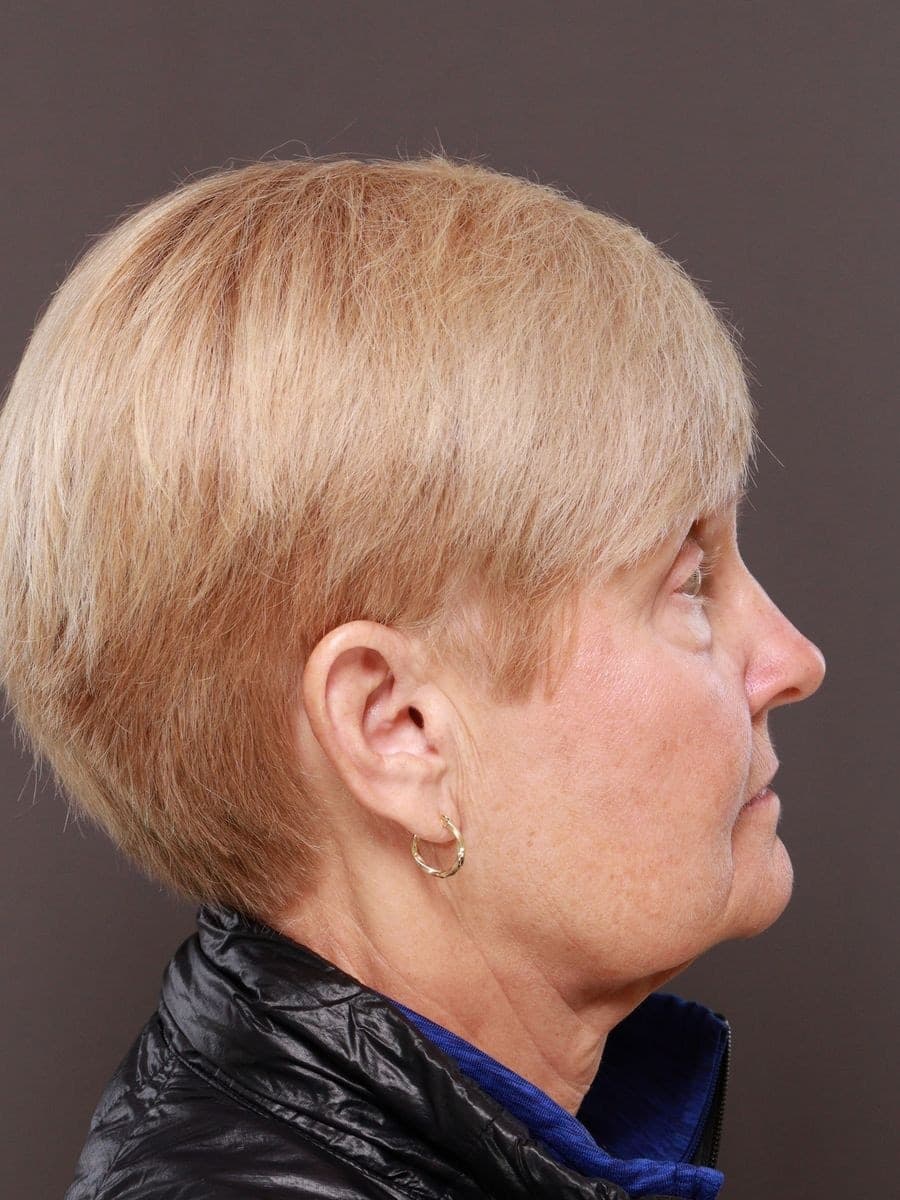
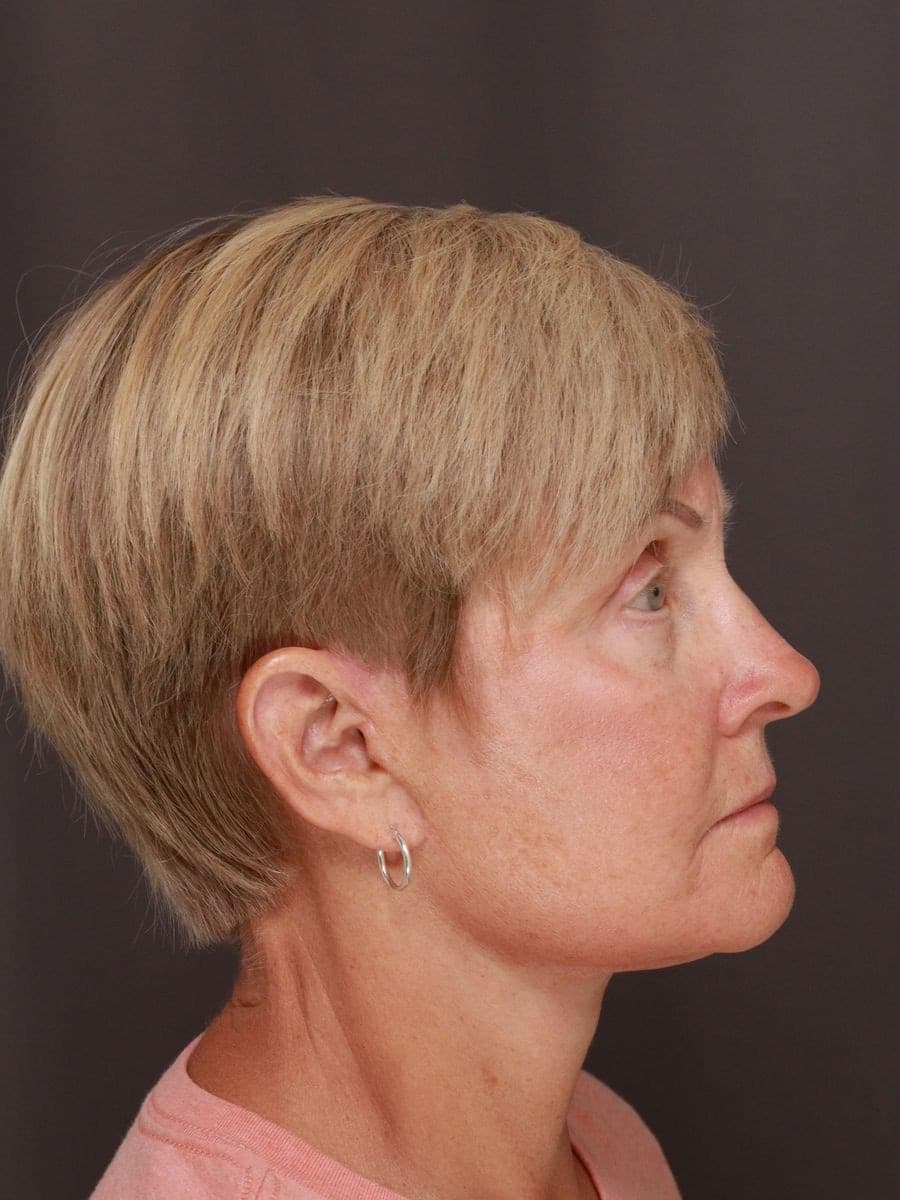
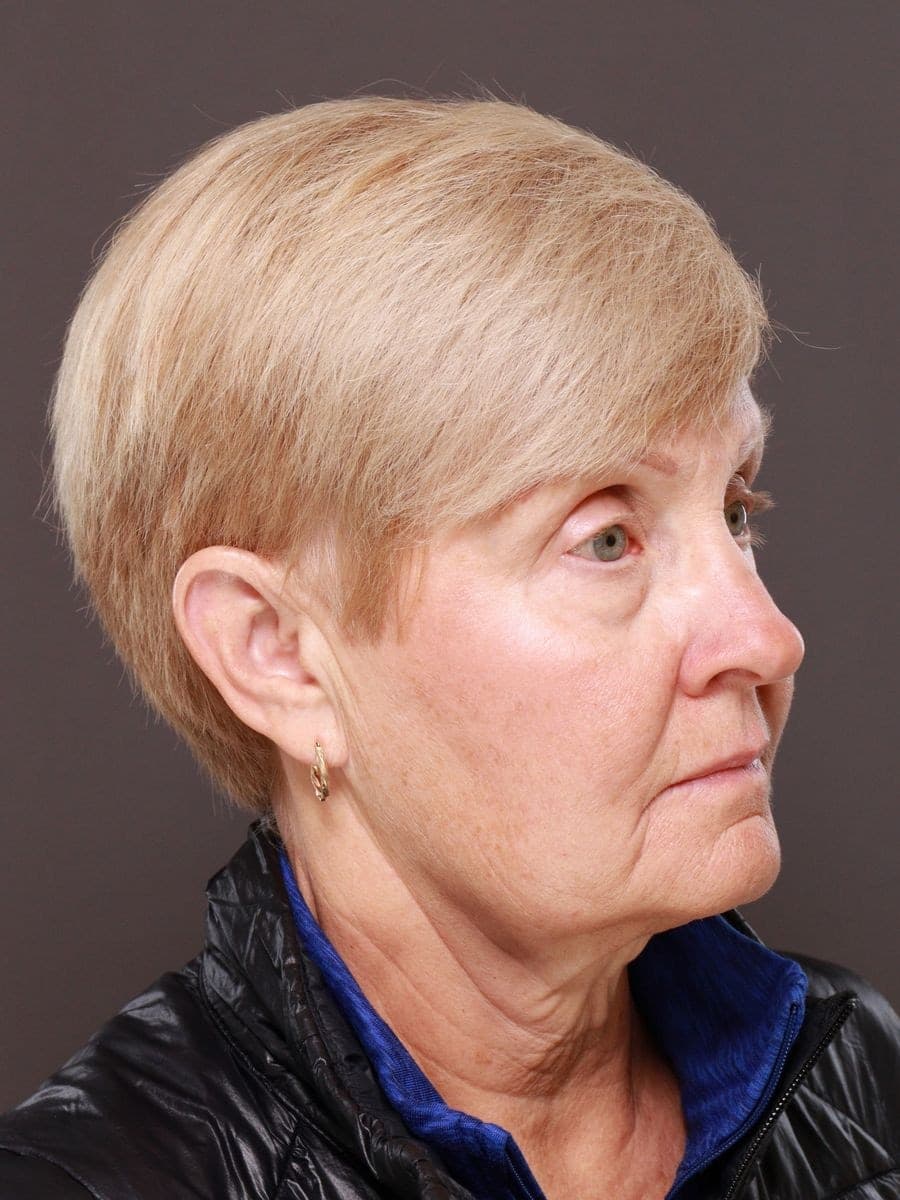
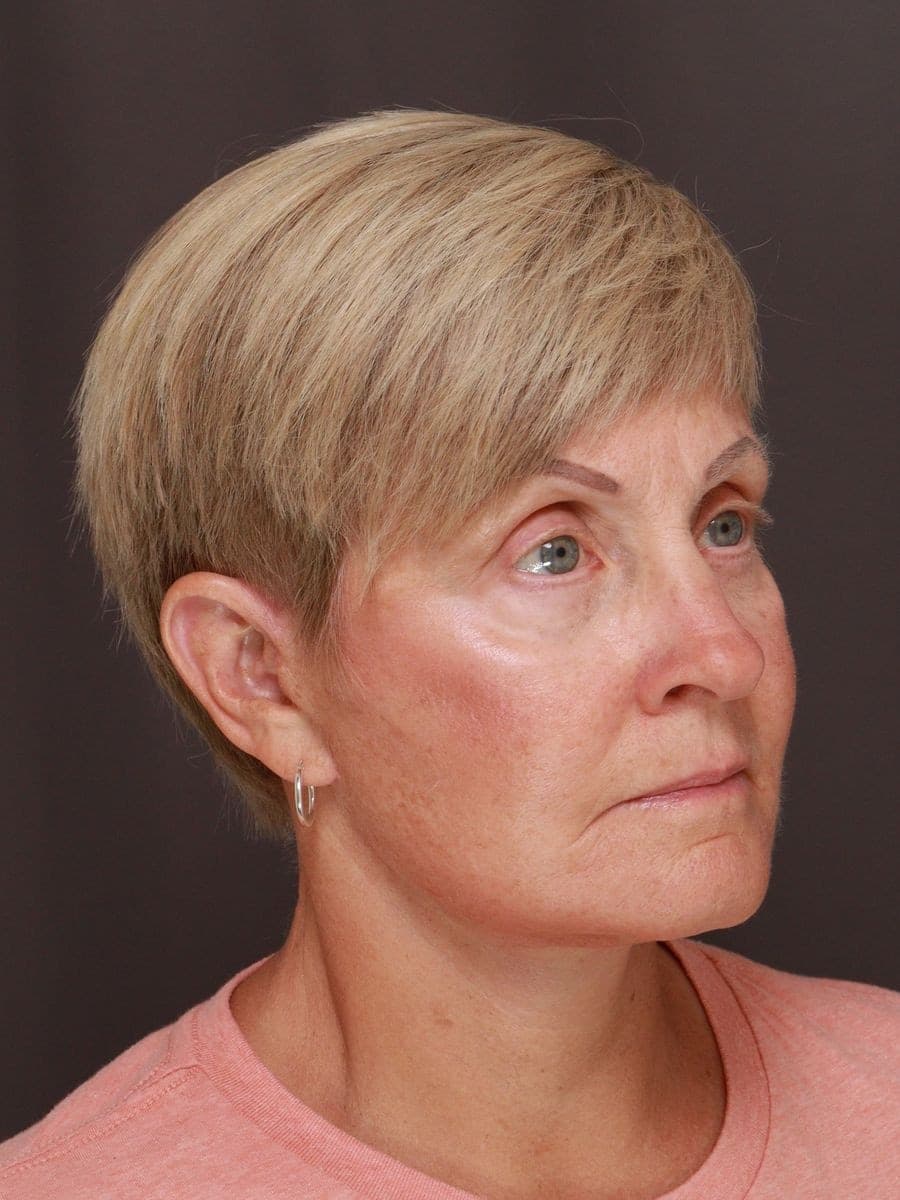
Deep plane facelift and necklift with lower blepharoplasty - 6 months post op
01 / 15
Day 0
Surgery day
About three hours, depending on your anatomy and any combined procedures. A short while in recovery, then home the same day.
Days 2–3
Peak swelling
Swelling and bruising crest around the second or third day — expected, and temporary.
Weeks 1–2
The hardest stretch
Some swelling and bruising continues; most patients take one to two weeks off work. The hardest stretch is also the shortest.
Weeks 2–3
Back in public
Many are comfortable in public by two to three weeks. Light cardio can usually resume around two weeks, strenuous activity around three.
3–6 months
Fully settled
Swelling continues to settle gradually; by three to six months healing is nearly complete, and any changes after that are subtle and slow.
A mini facelift focuses on the lower face and jawline, so it pairs naturally with procedures that refresh the areas it does not reach.
A brow lift elevates the eyebrow and opens the upper third of the face. Upper and lower blepharoplasty refreshes the eyes by removing excess skin and reducing fullness around them. Fat grafting restores lost volume in the cheeks and around the mouth. Laser resurfacing works at the surface — the mini facelift tightens and repositions the tissue, while the laser reduces the depth of wrinkles, smooths sun-damaged skin, and removes age spots. The two are especially synergistic.
Dr. James Manning is a double board-certified facial plastic surgeon, certified by the American Board of Facial Plastic and Reconstructive Surgery and the American Board of Otolaryngology–Head and Neck Surgery. The face is the central focus of his practice, supported by an ongoing commitment to continued learning and the refinement of technique. His goal in every procedure is the same: results that are undetectable and that last.
Medically reviewed by Dr. James Manning, MD · July 2026
A mini facelift is a short-scar facelift that tightens the lower face and jawline through a smaller incision around the ear. It repositions the SMAS — the firm sheet of connective tissue beneath the skin — to lift early jowling and mild laxity, and it is often performed under twilight sedation.
Both reposition the SMAS, but a mini facelift folds and tightens it through a shorter incision and concentrates on the lower face. A full deep plane facelift releases the SMAS completely and lifts the cheek, jowls, and neck together. A mini facelift suits early, limited aging; a full facelift handles heavier laxity and a sagging neck.
Patients with early jowling and mild laxity along the jawline, with a neck that is still relatively firm. Many candidates are in their late 30s to early 50s, though candidacy depends more on the amount of laxity in your skin and soft tissue than on your age alone.
A mini facelift generally lasts around five to ten years. How long it lasts depends on how much laxity you started with and how quickly you age afterward.
Because a mini facelift treats early, limited aging and folds the SMAS rather than releasing it fully, it does not set the clock back as far as a deep plane facelift — and that is the trade you accept for a shorter scar and a faster recovery. The lift does not stop aging. It sets the clock back a few years, and then the clock keeps running.
How fast it runs is the real variable. Many people notice changes through their fifties and sixties that pick up the pace of aging, and that pace differs from person to person.
A mini facelift restores position, but the quality of your skin keeps aging — and several treatments help maintain the result. Energy-based and light-based treatments — broadband light, laser resurfacing, microneedling, and chemical peels — help preserve the collagen and elastin in the skin. Medical-grade skin care supports the overall health of the skin, and bioidentical hormone replacement therapy may be an option as well.
broadband light · laser resurfacing · microneedling · chemical peels · medical-grade skin care
Swelling peaks around the second or third day, and most patients have some swelling and bruising for one to two weeks. Many take one to two weeks off work. Light cardio can usually resume around two weeks and strenuous activity around three weeks, while swelling continues to settle over several months.
Often no. Many mini facelifts can be performed as an outpatient under twilight sedation, where you are relaxed and comfortable but breathing on your own. When more area needs to be addressed, the procedure may be done under general anesthesia at a surgical center instead.
A mini facelift uses a shorter incision around the ear, where it sits in a natural crease. The scar is shorter than a full facelift incision and typically fades over the first several months.
A mini facelift is a smaller, conservative procedure that restores the jawline and softens early jowling rather than reshaping the whole face. The goal is to set the tissue back toward where it began, so the change is meant to be quiet — you look rested and a few years younger, not different.
A mini facelift addresses the lower face and the area right under the jaw, but it does not reach the lower neck. If you have significant neck laxity, a full facelift or a neck lift addresses the neck and face together.
The cost varies from patient to patient, depending on the extent of the procedure and whether it is combined with other treatments. A $150 consultation includes a complete evaluation, and you leave with a fully transparent quote detailing every cost — surgeon's fee, facility fee, and anesthesia fee. The consultation fee is applied toward any surgery, treatment, or product.
We would love to see you in consultation to determine whether a mini facelift would best fit your needs.
Inquire About Consultations801·317·8687