Facial plastic surgery in Salt Lake City, Utah
Insights, timelines, details, and more.
Request a ConsultationA brow lift repositions a sagging brow back to where it rested in earlier years. Working through a few short incisions hidden behind the hairline, the deeper tissue layers of the forehead are released and the brow is elevated and secured. It opens the eyes, lifts hooding at the outer lid, and softens the deep lines between the brows. Dr. James Manning performs the procedure in Salt Lake City, Utah.
A brow lift works underneath the forehead, at the deeper tissue layers that hold the brow down. I make two to four short incisions — each under an inch long — hidden behind the hairline. I don’t use an endoscope in most cases; the incisions give me direct visualization of all the critical structures involved in the lift.
Through them, I release the brow from the connections that anchor it to the bone of the orbital rim, and I soften the deeper tissue responsible for the vertical frown lines between the brows. Once the brow is free, I lift it up to a natural resting position and secure it there.
Because the lift is held on the deeper layers and the incisions sit behind the hairline, there is no incision across the forehead and no scar in view. The brow settles where it began — not pulled higher than it belongs.
A brow lift is a good fit if your brow has dropped toward the bony rim of the eye, leaving heaviness above the lids, hooding at the outer corner, or deep lines across the forehead and between the brows.
It suits patients who feel they look tired or stern at rest, or who notice they raise their forehead to hold the brow up. A short or normal forehead length and a stable hairline make the hidden-incision approach straightforward. Candidacy depends less on age than on how far the brow has descended and how much hooding has followed.
If your concern sits in the upper third of the face — the brow and the area above the eyes — a brow lift addresses it at the source.
A brow lift can be approached through different incisions, and the right one depends on your anatomy and your concern.
| Direct | Temporal | Endoscopic | |
|---|---|---|---|
| Where the incision sits | In the forehead skin, just above the brow. | Hidden behind the hairline — no incision in view. | Behind the hairline, plus a small camera (endoscope) inside. |
| Best suited to | Deep forehead lines. | Most patients — a short or normal forehead length and a stable hairline. | Cases where reducing the frown-line muscles is the main goal. |
| The trade-off | A visible incision line in the forehead skin. | Direct visualization of every structure being lifted, without a camera. | Not necessary in the vast majority of cases. |
One of the most common fears patients raise about a brow lift is the “surprised” or startled look — a brow pulled too high, a forehead frozen smooth, a face that no longer reads as their own:
The principle is straightforward: lift the brow fully while keeping the incisions as small and as hidden as possible.
In past years, a brow lift meant an incision running across the top of the head, from ear to ear — effective, but leaving a long scar and a numb scalp behind it. Working through a few short incisions behind the hairline changes that: no incision across the forehead, less disruption to the sensory nerves of the scalp, and a faster recovery. The lift itself is held on the deeper tissue layers, so the result holds without depending on the skin.
Dr. Manning matches the technique to your anatomy rather than running every brow through the same template. A high hairline, a deeply descended outer brow, or a forehead that has lost movement may call for a different incision — and that is a decision made together, not a default.
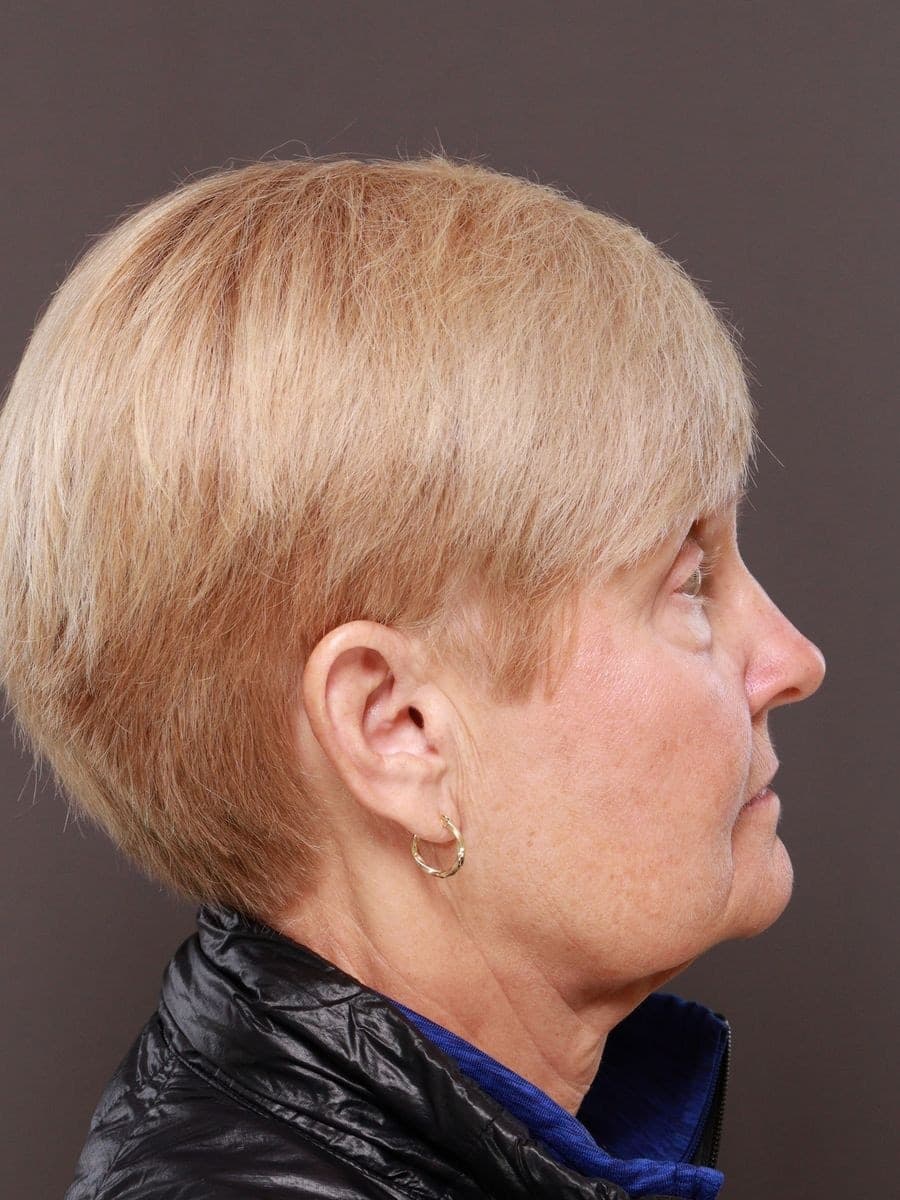
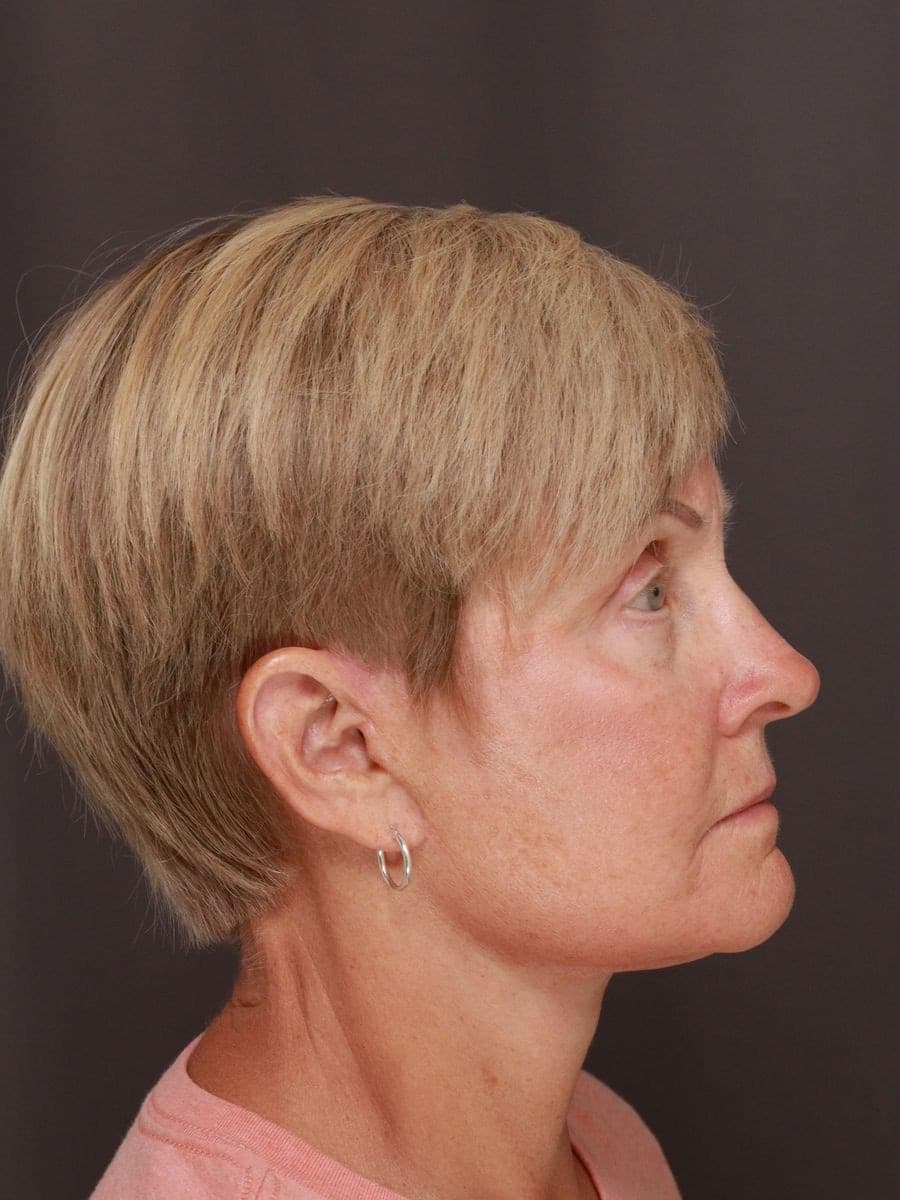
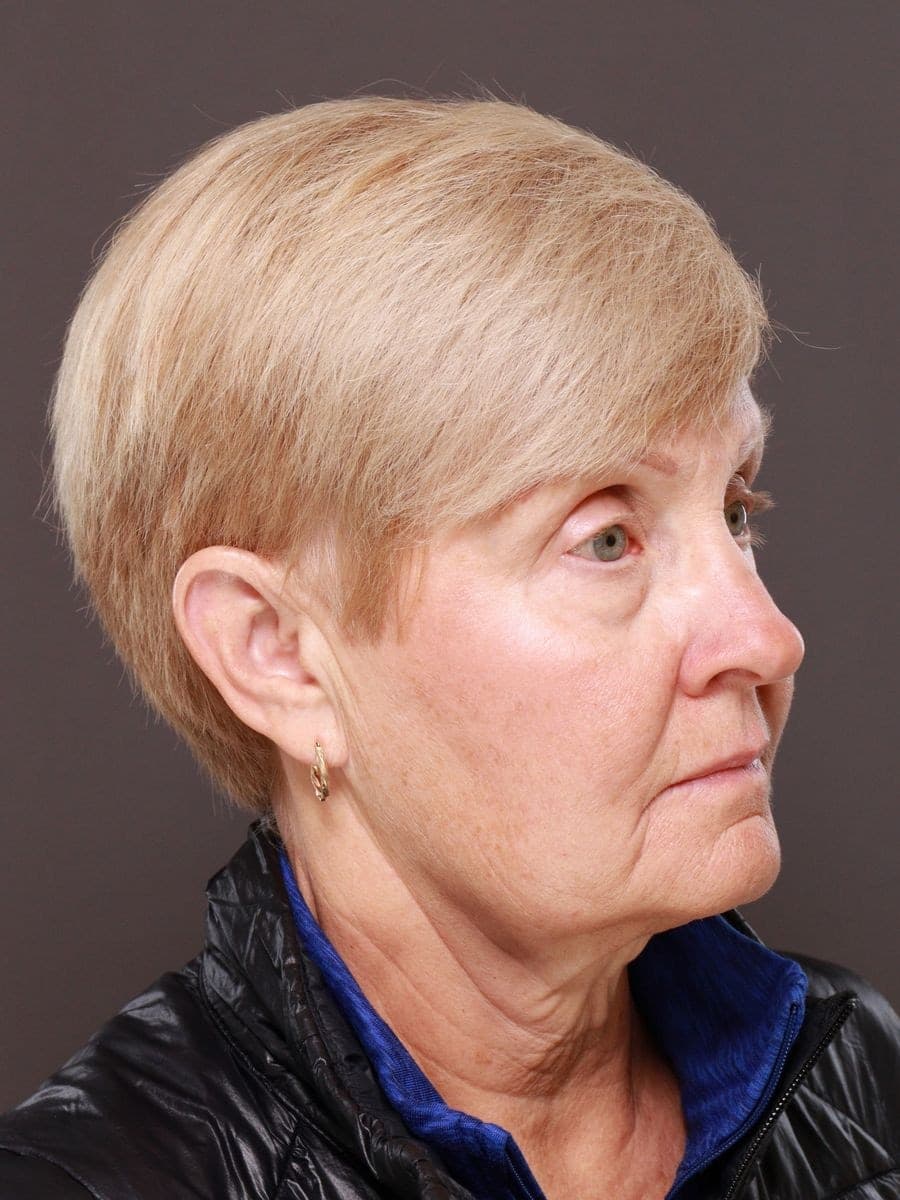
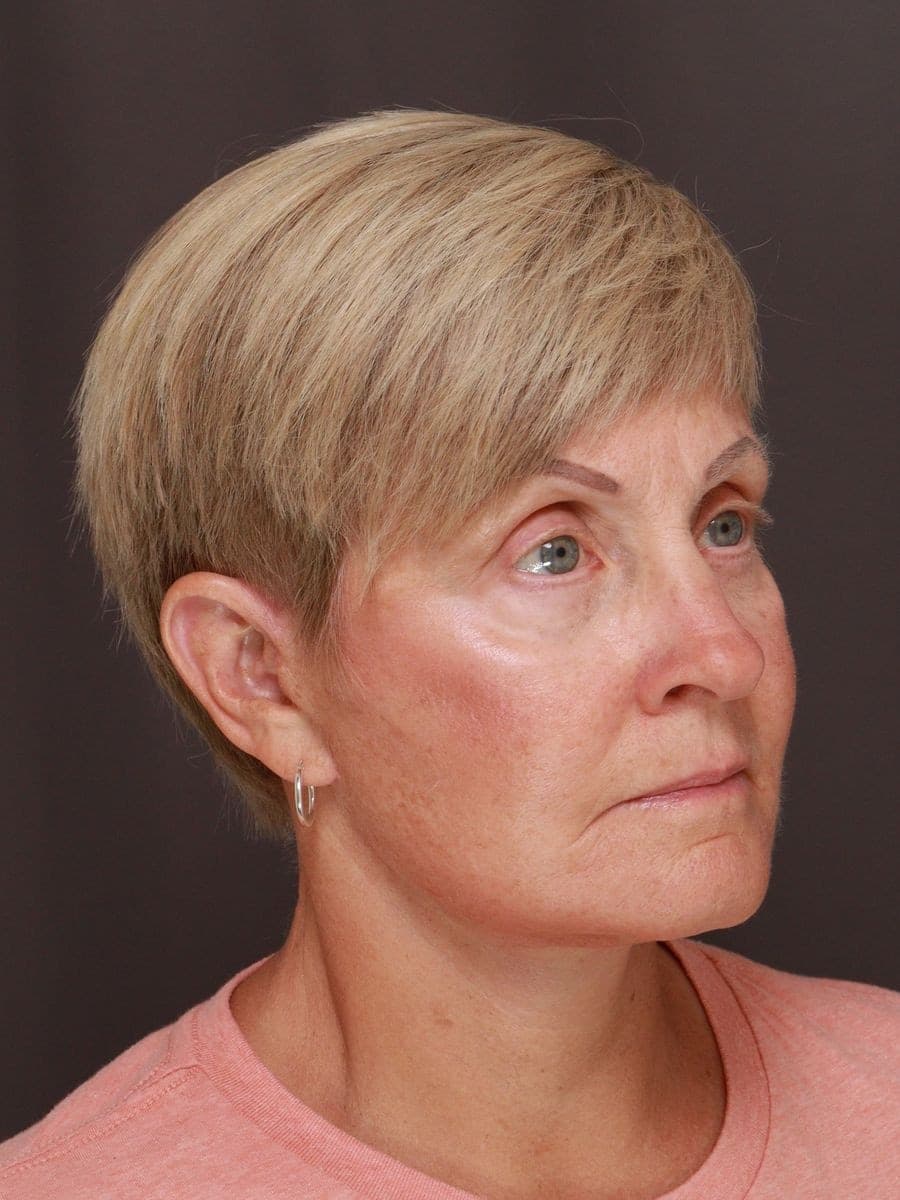
Deep plane facelift and necklift with lower blepharoplasty - 6 months post op
01 / 15
Day 0
Surgery day
One to two hours, depending on your anatomy and any combined procedures. An hour or two in recovery, then home.
Days 2–3
Peak swelling
Swelling and bruising crest around the second or third day and begin settling by day four or five; bruising may track down toward the eyes.
Weeks 1–2
The hardest stretch
Fairly swollen and bruised while your body recovers. The hardest stretch is also the shortest.
Days 10–14
Back to work
Most patients return to non-physical work once bruising has faded enough to cover or has resolved.
3–6 months
Fully settled
Tightness and numbness across the forehead resolve over weeks to months as the brow settles into its final position.
A brow lift restores the upper third of the face, so it pairs naturally with procedures that address the eyes and the lower face.
Upper and lower blepharoplasty refreshes the eyes by removing excess eyelid skin and reducing fullness around them — and because a low brow can be the underlying cause of upper-lid hooding, the two are often planned together. A deep plane facelift restores the lower two-thirds of the face, so combining it with a brow lift treats the whole face at once. Laser resurfacing works at the surface, reducing the depth of forehead and brow lines that a lift repositions but does not erase.
Dr. James Manning is a double board-certified facial plastic surgeon, certified by the American Board of Facial Plastic and Reconstructive Surgery and the American Board of Otolaryngology–Head and Neck Surgery. The face is the central focus of his practice, supported by an ongoing commitment to continued learning and the refinement of technique. His goal in every procedure is the same: results that are undetectable and that last.
Medically reviewed by Dr. James Manning, MD · July 2026
A direct brow lift places the incision in the forehead skin just above the brow and works well for deep forehead lines; a temporal lift places it behind the hairline. An endoscopic brow lift adds an endoscope, which can help reduce the corrugator muscles behind the frown lines but isn't necessary in most cases. The right approach depends on your hairline, forehead length, and how much lift you need.
With a hidden-incision brow lift, the surgeon typically uses two to four short incisions under an inch long placed behind the hairline, which keeps them well camouflaged. In a systematic review of brow lift techniques, unacceptable scarring was reported in roughly 2–4% of patients depending on the incision type, which is why incision planning is an important part of the consultation.
A well-chosen brow lift technique is designed to lift the brow without significantly raising the hairline. Research on brow lifts found significant brow elevation while forehead height did not change to a significant degree, which is one reason the technique is matched to a patient's existing hairline and forehead length.
Studies suggest brow lift results are durable — measurable brow elevation has been shown to persist for years after surgery.
A brow lift does not stop aging — it resets the brow to a higher, more rested position, and from there the clock keeps running. How quickly it runs differs from person to person, and depends on how much descent you started with and how your skin ages afterward.
A brow lift restores position, but the quality of your skin continues to age — and several treatments help maintain the result. Energy-based and light-based treatments — broadband light, laser resurfacing, microneedling, and chemical peels — help preserve the collagen and elastin in the skin. Medical-grade skin care supports the overall health of the skin, and neuromodulators can soften the frown lines between the brows over time.
broadband light · laser resurfacing · microneedling · chemical peels · medical-grade skin care · neuromodulators
The “surprised look” is generally associated with older techniques that lifted the brow too high or overtightened the central forehead. The goal is to preserve natural brow shape — often elevating the outer brow more than the inner portion and keeping natural movement — so the brow is restored to position rather than over-elevated.
Swelling and bruising typically peak around the second or third day and begin to subside by about the fourth or fifth, with many patients returning to non-physical work in roughly ten to fourteen days. The result continues to refine over about three to six months as residual swelling resolves.
A brow lift is often considered for a heavy or descended brow, hooding at the outer eyelid, and deep forehead or frown lines, which tend to develop as the brow descends toward the bony rim with age. Candidacy is typically best for patients with a short or normal forehead length and a stable hairline, and the plan is guided by how far the brow has descended.
The two address different problems: upper blepharoplasty removes excess eyelid skin, while a brow lift repositions a sagging brow that may be the underlying cause of the hooding. Because removing eyelid skin without lifting a low brow can let the brow descend further, the two are sometimes planned together — which is why brow position is part of the evaluation.
Temporary numbness or altered sensation in the forehead and scalp is a recognized effect of brow lift surgery because sensory nerves run through the area. In a systematic review, altered sensation was reported in roughly 5–6% of patients across techniques; it is often temporary and tends to improve over time, while persistent numbness is less common when sensory nerves are identified and protected.
The cost varies from patient to patient, depending on the technique used and whether it is combined with other procedures. A $150 consultation includes a complete evaluation of your brow, eyelids, and hairline, and you leave with a fully transparent quote detailing every cost — surgeon's fee, facility fee, and anesthesia fee. The consultation fee is applied toward any surgery, treatment, or product.
We would love to see you in consultation to determine whether a brow lift would best fit your needs.
Inquire About Consultations801·317·8687