
Facial plastic surgery in Salt Lake City, Utah
Insights, timelines, details, and more.
Request a ConsultationA deep plane necklift is a neck-only deep plane operation that releases and tightens the deeper tissue layers of the neck and removes excess skin. It deepens the cervical angle, the angle between the chin and the neck, and refines the jawline. It addresses the neck and jawline only, not the face, and suits patients with neck skin laxity who are not ready for a full facelift. Dr. James Manning performs the procedure in Salt Lake City, Utah.
A deep plane necklift works in the same glide plane as a deep plane facelift, but in the neck only. I release the tethering points that hold the deeper tissue layers of the neck down to the firm structures underneath, so those layers are free to move. Once they are released, I tighten and resuspend them to deepen the cervical angle and sharpen the jawline.
Because the deeper layers carry the lift, the excess skin can then be re-draped and trimmed without tension. The deep work, the tightening, and the skin excision are all part of one operation. The lift is held on the deeper tissue, not on the skin — so the skin closes without being pulled.
A deep plane necklift is a good fit if your main concern is the neck and jawline — fullness under the chin, a blunted neck angle, jowling — and you have developed some skin laxity in the neck, but you are not ready for a full facelift.
It suits patients who are happy with their cheeks and brow area but want to define the neck and jawline. Many good candidates have noticed that the neck has lost its angle and the jawline has softened, and that loose skin has started to appear along the neck. The deep plane necklift addresses the deeper tissue layers and the loose skin together.
If your concerns sit in the neck and jawline rather than across the whole face, a deep plane necklift addresses them directly.
A deep plane necklift and deep neck contouring both address the deeper tissue layers of the neck, and both deepen the cervical angle. The difference is the skin.
| Deep Plane Necklift | Deep Neck Contouring | |
|---|---|---|
| How far the deeper layers are treated | Releases and tightens the deeper tissue layers of the neck, then removes excess skin. | Reduces the deeper structures and tightens the platysma — the broad, flat sheet of muscle that wraps the front of the neck — through a small incision under the chin, without removing skin. |
| Best suited to | Patients who have developed neck skin laxity in addition to fullness. | Patients with fullness but a good skin envelope, without significant laxity. |
| Skin | Excess skin is removed as part of the operation. | No skin is removed. |
| The result | Deepens the cervical angle and refines the jawline where loose skin is also present. | Deepens the cervical angle for a good skin envelope. |
A deep plane necklift and a deep plane facelift use the same deep plane principle — releasing the deeper tissue layers (the SMAS-platysma layer, the connective and muscular sheet beneath the skin) fully so they can be repositioned without tension. The difference is how much of the face is treated: a deep plane facelift lifts from the corner of the eye to the clavicles, addressing the cheek, the jowls, and the neck together, while a deep plane necklift does not address the face above the corner of the mouth. For a patient happy with the cheeks and brow but wanting to work on the neck and jawline, the necklift is often the better fit; for a patient with laxity across the face as well as the neck, the deep plane facelift addresses both at once.
The most common fear patients express is that they will no longer look like themselves, or that the result will appear unnatural:
Preservation techniques have become widespread in surgery in recent years, and they are useful in the neck as well as the face. The principle is simple: elevate the least amount of skin possible while still achieving a natural result.
Keeping the skin attached to the deeper tissue wherever possible — the same tissue that now carries the weight of the lift — does two things. First, the tension is spread more evenly across the skin, which is safer. Second, it leaves less open space beneath the skin for fluid to collect.
That second point matters more than it sounds. Collected fluid is what drives bruising and slows healing, so reducing the space available for it makes a real difference. It is also why this technique can be performed without drains.
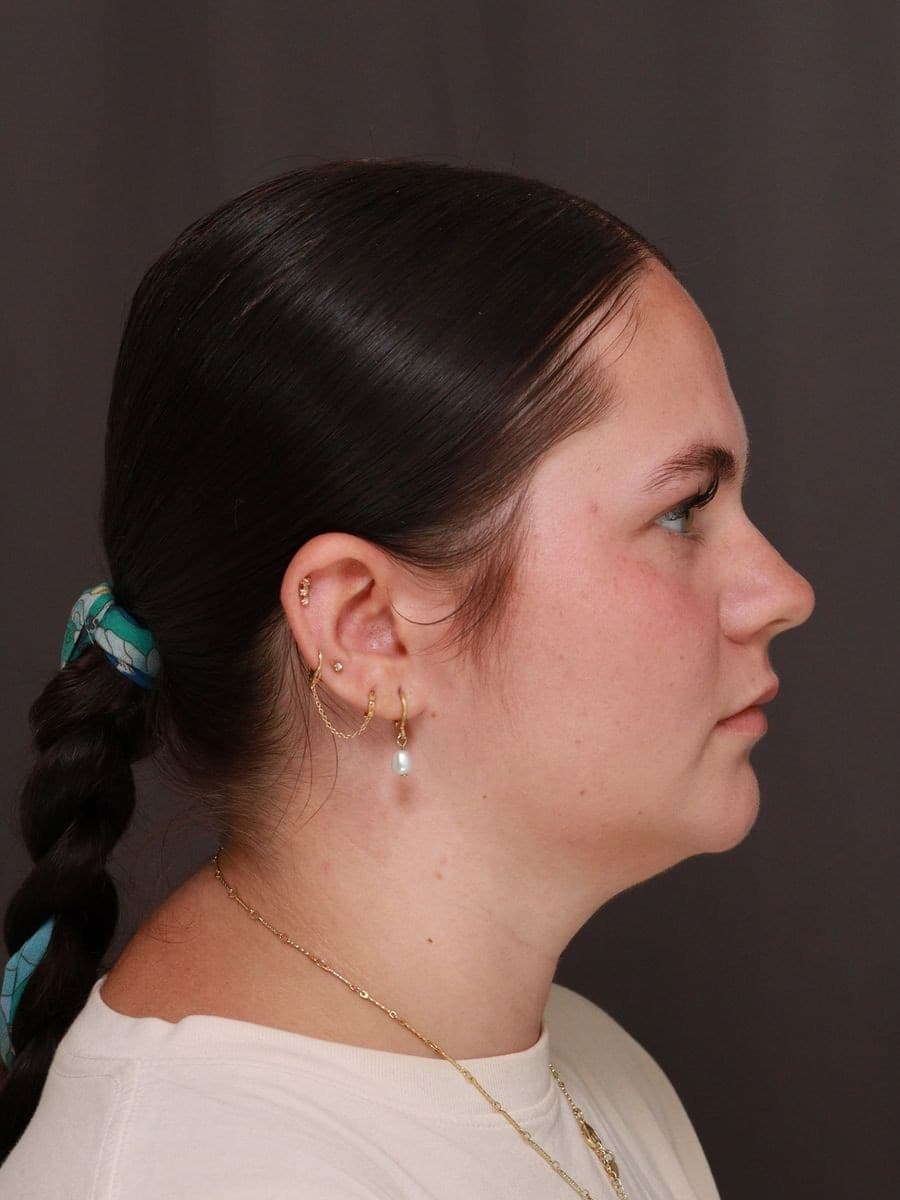

Deep neck contouring with chin implant - 6 months post-op
01 / 10
Day 0
Surgery day
General anesthesia in most cases. An hour or two in recovery, then home the same day.
Days 1–5
Head wrap
A head wrap is worn around the clock for the first five days, then at night only for another seven days.
Weeks 1–3
Bruising fades
Bruising and swelling improve significantly; activity stays restricted for three weeks.
Weeks 2–3
Feeling confident
Most patients start feeling confident about their result — though the neckline can look swollen again before it settles.
4–6 months
Fully settled
Swelling continues to resolve through three to four months, with full results visible at four to six months.
A deep plane necklift restores the neck and jawline, so it pairs naturally with procedures that balance the profile or address the deeper structures of the neck.
Adding chin projection at the time of surgery has a synergistic effect — it balances the profile, elongates the jawline, and deepens the neck angle beyond what soft-tissue work alone can achieve. A chin implant strengthens the jawline in a way filler cannot; for a patient who wants chin projection without an implant, a chin pexy addresses a drooping chin pad through the same incision. Where there is significant deep fullness, the deeper structures of the neck — subplatysmal fat, the digastric muscles, and the submandibular glands — can be addressed at the same time through deep neck contouring, or combined with a full deep plane facelift for patients with laxity across the face as well.
Dr. James Manning is a double board-certified facial plastic surgeon, certified by the American Board of Facial Plastic and Reconstructive Surgery and the American Board of Otolaryngology–Head and Neck Surgery. He specializes exclusively in the face, supported by an ongoing commitment to continued learning and the refinement of technique. He has contributed to published book chapters on face-lifting techniques, including a chapter on the surgical approach to the deep structures of the neck. His goal in every procedure is the same: results that are undetectable and that last.
Medically reviewed by Dr. James Manning, MD · July 2026
A deep plane necklift is a neck-only deep plane operation that releases and tightens the deeper tissue layers of the neck and removes excess skin. It deepens the cervical angle and refines the jawline, and it suits patients with neck skin laxity who are not ready for a full facelift. Surgical literature describes the deep plane neck-lifting approach as releasing the tethering points that hold these layers down so they can be repositioned and resuspended (Talei et al., 2024).
Both address the deeper tissue layers of the neck, but deep neck contouring works through a small incision under the chin and is for patients without significant skin laxity — it does not remove excess skin. A deep plane necklift releases and tightens the deeper layers and removes excess skin, which is why it suits patients who have developed neck skin laxity.
A neck lift addresses the neck and jawline and does not affect the face above the corner of the mouth, while a deep plane facelift lifts from the corner of the eye to the clavicles. If your concerns are limited to the neck and jawline and you are happy with your cheeks and brow, a deep plane necklift addresses them directly. If you have laxity across the face as well, a deep plane facelift addresses both.
Often, yes. The deep plane necklift is designed for patients who are primarily concerned with neck fullness, a blunted neck angle, and jowling, who have developed some neck skin laxity, but who are happy with their cheeks and brow and are not ready for a full facelift.
The deep plane approach is designed to avoid a tight, operated look. When the deeper tissue layers are fully released, they can be repositioned without fighting the attachments that hold them down, and the skin is re-draped and trimmed without tension. Surgical literature on deep plane neck lifting reports that techniques which release tension and allow the skin to redrape produce natural, well-balanced results (Talei et al., 2024).
Some neck procedures can be performed awake under local anesthesia, which is worth discussing if you want to avoid general anesthesia. There are structures in the neck that can only be safely addressed with the patient asleep in the OR, so the scope of what is achievable awake is more limited. We clarify what is and isn't achievable at consultation.
Bruising and swelling improve significantly in the first two to four weeks, and activity is restricted for three weeks. Most patients feel confident in their result around two to three weeks, with swelling continuing to resolve through three to four months and full results visible at four to six months.
One thing worth noting: the neckline will often become swollen at one to two weeks, to the point that it looks almost as full as it did before surgery. This is not something to worry about — results take time to develop, and the neckline often looks better than it did before surgery early in the course before settling slowly over time.
For out-of-state patients, a seven to ten day stay in Salt Lake City is sufficient before flying home to complete recovery. Keeping this timeline in mind — and being patient with it — is part of the process.
No. The preservation technique keeps the skin attached to the deeper tissue wherever possible, which leaves less space for fluid to collect. That allows the necklift to be performed without drains, with less bruising.
The structural changes from a deep plane necklift are lasting. The deeper tissue layers are released and resuspended, the excess skin is removed, and that repositioning holds. The long-term appearance of the neck is influenced by weight changes and the natural aging of the skin over time, but the deeper anatomy has been addressed.
When a patient has significant laxity, that tissue can be repositioned to where it sat years earlier. The necklift does not stop aging — it sets the clock back, and then the clock keeps running. How fast it runs differs from person to person.
A necklift restores position, but the quality of your skin continues to age — and several treatments help maintain the result. Energy-based and light-based treatments — broadband light, laser resurfacing, microneedling, and chemical peels — help preserve the collagen and elastin in the skin, which adds longevity to the tissues. Medical-grade skin care supports the overall health of the skin, and maintaining a stable weight helps preserve the result.
broadband light · laser resurfacing · microneedling · chemical peels · medical-grade skin care
In experienced hands, neck and face lifting has a well-established safety profile, and serious complications are uncommon. As with any surgery, risks include temporary swelling, bruising, numbness, and asymmetry, and the rare nerve issues that occur are almost always temporary. A deep knowledge of facial and neck anatomy is what makes the procedure safe, and a thorough consultation — including a review of your anatomy and medical history — is the place to discuss your individual risk profile (Derby & Codner, 2017).
If your concerns sit in the neck and jawline and you are not ready for a full facelift, a deep plane necklift may be worth discussing. We would love to see you in consultation to determine if this procedure would best fit your needs.
Inquire About Consultations801·317·8687


