
Facial plastic surgery in Salt Lake City, Utah
Insights, timelines, details, and more.
Request a ConsultationA chin implant — also called chin augmentation or mentoplasty — is an alloplastic implant (a solid implant made of an inert, non-living material) placed over the chin bone to add projection to a recessed or weak chin. It balances the profile, elongates the jawline, and provides structural support that filler cannot match. The procedure adds permanent projection through a small, hidden incision.
A chin implant adds projection to the chin by placing a solid implant — usually silicone — directly over the bone of the chin, beneath the periosteum, the thin tissue layer that covers the bone. The implant sits flush against the bone and becomes a permanent part of the structure of the lower face.
The implant is placed through a small incision, either inside the mouth or in a hidden crease under the chin. It is positioned and sized to the projection your profile needs, then the incision is closed. Because the implant rests against the bone and is held by the deeper tissue layers around it, it stays in position.
Once the chin is projected, the profile is balanced and the jawline is elongated. The verdict is structural: a chin implant strengthens the lower face in a way that adding volume to the surface cannot. Dr. James Manning performs the procedure in Salt Lake City, Utah.
A chin implant is a good fit if you have a weak or recessed chin — what surgeons call microgenia (an under-projected, recessed chin) — and want more projection to balance your profile. Many good candidates have noticed that their chin sits back relative to the rest of the face, that their profile looks unbalanced, or that a recessed chin makes the neck look fuller than it is.
It suits patients who want to strengthen and define the jawline, lengthen the lower face, and bring the chin into proportion with the nose and forehead. A weak chin can make an otherwise normal neck appear full, so patients concerned about the neck and jawline together are often good candidates.
Candidacy depends less on age and more on the structure of your lower face. The best candidates have good skin and a chin that is under-projected for their anatomy. We confirm whether a chin implant fits you at your consultation.
Filler can augment the chin and is a good option for many patients. Hyaluronic acid filler adds volume without surgery, the result is temporary and reversible, and it is a reasonable way to preview added projection before committing to anything permanent. What filler does not have are the structural benefits of an implant.
| Chin Implant | Filler | |
|---|---|---|
| Mechanism | Rests against the bone and projects the chin from the skeleton outward. | Sits in the soft tissue above the bone, adding fullness without skeletal support. |
| Best suited to | A recessed chin that needs real structural projection — a stronger jawline and a balanced profile. | Mild volume deficiencies, or previewing added projection before surgery. |
| Comfort | A short procedure through a small, hidden incision. | No incision — placed by injection. |
| The result | A one-time, permanent change. | Temporary and reversible — the result is absorbed over time. |
A common concern patients raise about any implant is that the result will look done, or that the chin will no longer look like it belongs to their face:
A chin implant is one of several ways to address the chin, and the right one depends on the problem. A chin implant adds projection by placing a solid implant over the bone. It is the most direct way to strengthen a recessed chin and elongate the jawline.
A chin pexy addresses a different problem — a drooping chin pad, where the soft tissue of the chin has descended — and lifts it without placing an implant. For a patient whose chin sags rather than sits back, a chin pexy is the better tool, and it can be done through the same incision used for deep neck contouring.
A sliding genioplasty moves the chin bone itself. The surgeon cuts the lower jawbone and slides it forward, which can correct larger discrepancies or address the vertical height of the chin without an implant. It is a bony procedure, more involved than an implant, and reserved for cases where moving the skeleton is the right answer.
For most patients seeking added projection, a chin implant is the simplest, most predictable option. We match the procedure to your anatomy at your consultation.
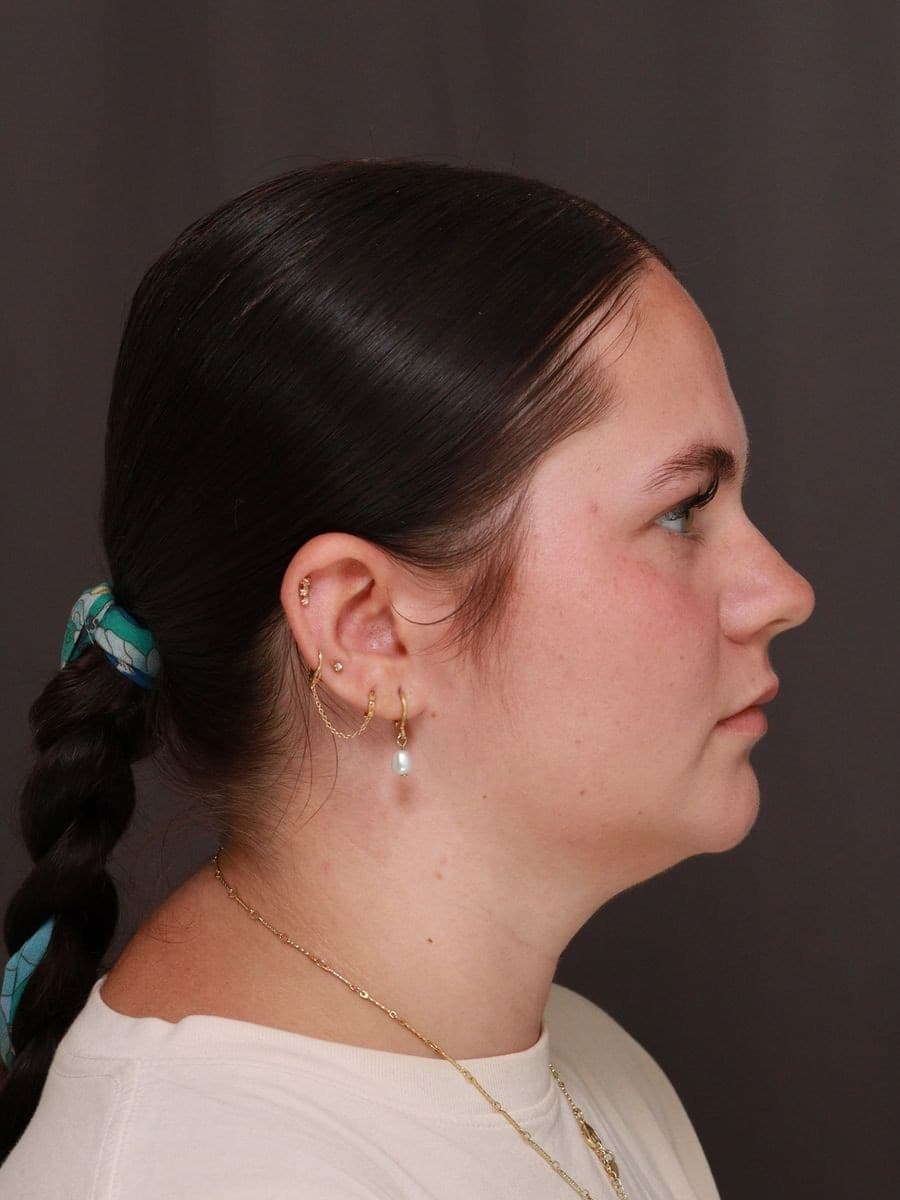
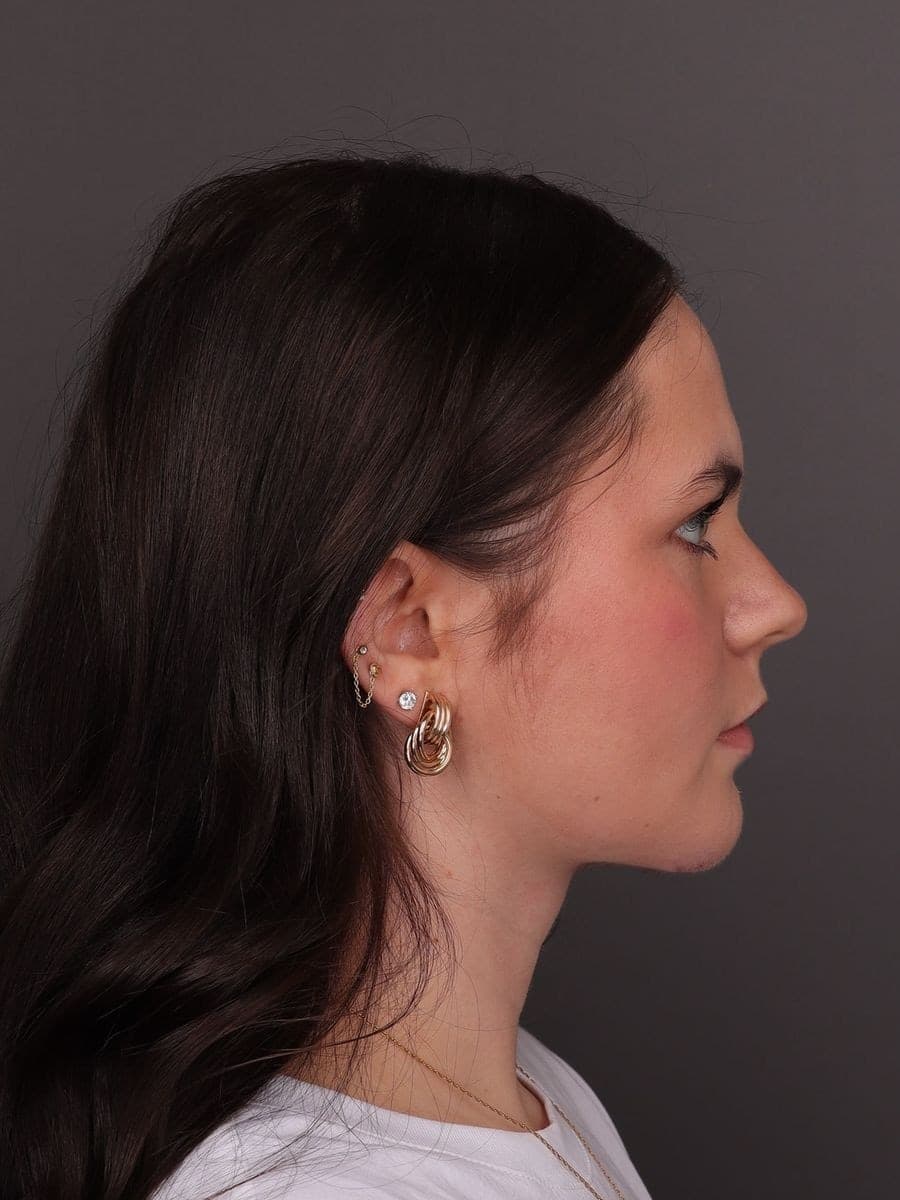
Deep neck contouring with chin implant - 6 months post-op
01 / 10
Day 0
Procedure day
A short procedure on its own — the implant is placed and sized, the incision closed, and most patients go home the same day.
Days 1–14
Swelling and bruising
Normal around the chin and neck in the first one to two weeks, improving steadily as the early swelling settles.
~2 weeks
Feeling presentable
Most patients placing a chin implant on its own feel presentable within a couple of weeks.
Early weeks
Tightness and numbness
Tightness, numbness, or an odd sensation at the chin and lower lip is common as the tissue heals — expected, and almost always temporary.
A few months
Final contour
The chin continues to settle as residual swelling resolves; the final contour becomes clear by a few months out. Patience is part of the process.
A chin implant addresses projection, so it pairs naturally with procedures that address the neck and jawline.
Placing a chin implant at the time of deep neck contouring has a synergistic effect. Adding projection to the chin both balances the profile and elongates the jawline, which helps reduce the appearance of jowling and enhances the effect of contouring the soft tissue under the chin. The combination of contouring and tightening the neck along with adding projection to the chin allows for the deepest possible neck angle.
A chin implant also pairs with submental liposuction, where projecting the chin deepens the neck angle that liposuction alone leaves underwhelming, and with a deep plane necklift for patients addressing more advanced laxity.
Dr. James Manning is a double board-certified facial plastic surgeon, certified by the American Board of Facial Plastic and Reconstructive Surgery and the American Board of Otolaryngology–Head and Neck Surgery. He specializes exclusively in the face. He commonly places chin implants at the time of deep neck contouring and necklift surgery, where adding chin projection deepens the neck angle and elongates the jawline.
Medically reviewed by Dr. James Manning, MD · July 2026
A chin implant is a solid implant — usually silicone — placed over the bone of the chin to add projection to a recessed or weak chin. It is also called chin augmentation or mentoplasty. It balances the profile and elongates the jawline, and the result is permanent.
They are different tools for different problems, not better and worse. Filler adds volume in the soft tissue and is a good, reversible option for mild cases. A chin implant rests against the bone and provides structural support, which strengthens the jawline far more than filler can — and unlike filler, it does not absorb over time. For a recessed chin that needs real projection, an implant does what filler cannot.
Patients with a weak or recessed chin — microgenia — who want more projection to balance the profile and define the jawline. A recessed chin can also make the neck look fuller than it is, so patients concerned about the neck and jawline together are often good candidates. Candidacy depends more on the structure of your lower face than on your age.
When the implant is sized to the projection your profile actually needs, it reads as a stronger, better-proportioned version of your own face rather than a new chin. The result that looks operated is usually one that was over-projected. Restoring balance — rather than maximizing projection — is what keeps a chin implant natural.
Swelling and bruising are normal for the first one to two weeks and improve steadily. Most patients placing a chin implant on its own feel presentable within a couple of weeks. Numbness or tightness at the chin and lip is common early on and almost always temporary, and the final contour is clear within a few months.
Yes, for most patients. A chin implant is permanent — it does not dissolve or absorb the way filler does, so the projection it provides is lasting. For most patients, a chin implant is a one-time procedure.
The structural change holds over time. The bone beneath a silicone chin implant can remodel slightly — in a long-term radiographic study, fourteen of fifteen patients showed minor bone changes under the implant, all of them small (no more than 2 millimeters) and none causing any symptoms or affecting the result. (Bovenzi CD, et al. Plast Reconstr Surg Glob Open. 2018; PMID 30175015) The implant continues to provide projection over the long term.
What changes over time is the skin and soft tissue around the chin, which continue to age naturally. The skeletal projection an implant provides does not. For most patients, the result of a chin implant lasts indefinitely.
Some minor remodeling of the bone under a silicone implant can occur over the long term, but it is small and does not affect the result. In a long-term radiographic study, fourteen of fifteen patients showed bone changes under their silicone chin implant, all measuring no more than 2 millimeters and none causing any symptoms. (Bovenzi CD, et al. Plast Reconstr Surg Glob Open. 2018; PMID 30175015)
A chin implant has a well-established safety profile. In a systematic review of more than 3,100 patients, silicone, porous polyethylene, and Gore-Tex implants all had low overall complication rates. With the placement technique against the bone beneath the periosteum, the rates of implant revision (about 1 in 100) and removal (about 1 in 100) were low. (Liao CD, et al. Ann Plast Surg. 2023; PMID 36880789) As with any surgery, risks include temporary swelling, bruising, numbness, and, uncommonly, infection, shifting, or asymmetry, which your consultation is the place to review.
Yes — this is one of the most common combinations. Placing a chin implant at the time of deep neck contouring has a synergistic effect: it balances the profile, elongates the jawline, and deepens the neck angle beyond what contouring the soft tissue alone can achieve. For patients who want chin projection without an implant, a chin pexy addresses a drooping chin pad through the same incision.
A chin implant is placed through a small incision, either inside the lower lip — where there is no external scar at all — or in a hidden crease under the chin. Both approaches are designed to keep any scar inconspicuous. We discuss which approach fits your anatomy at your consultation.
Your consultation includes a complete evaluation of your anatomy and goals. From there, we build a plan specific to you, and you'll leave with a fully transparent quote detailing every cost: the surgeon's fee, the facility fee, and the anesthesia fee. Your $150 consultation fee is applied toward any surgery, treatment, or product.
We would love to see you in consultation to determine if a chin implant would best fit your needs.
Inquire About Consultations801·317·8687


