
Facial plastic surgery in Salt Lake City, Utah
Insights, timelines, details, and more.
Request a ConsultationDeep neck contouring is a surgical procedure that addresses the deeper tissue layers of the neck — including fat beneath the platysma (the broad sheet of muscle spanning the front of the neck), enlarged digastric muscles (paired muscles beneath the jaw that help open the mouth), and submandibular glands (saliva-producing glands sitting below the jawline) — through a small incision under the chin. It deepens the cervical angle and defines the jawline in ways liposuction alone cannot achieve.
The procedure begins with liposuction to remove subcutaneous fat, then goes deeper — beneath the platysma muscle — to reduce interplatysmal and subplatysmal fat, contour enlarged digastric muscles, and reduce submandibular gland volume where needed. The platysma is then tightened and suspended anteriorly to refine the jawline and deepen the cervical angle. Dr. James Manning performs the procedure in Salt Lake City, Utah.
Deep neck contouring is best suited for patients with fullness under their chin and a blunted neck angle that persists despite weight loss or being at their ideal weight. Patients should have minimal skin laxity — this procedure does not address excess skin.
It is generally well suited for patients under 40 who have significant subplatysmal fat, enlarged digastric muscles, enlarged submandibular glands, or a low and anteriorly positioned hyoid bone — the U-shaped bone in the upper neck that helps define the cervical angle.
Submental liposuction removes fat beneath the skin and can produce meaningful improvement in the right patient. For many, though, the result is subtle — and for patients with a blunted neck angle, significant jowling, or fullness that persists despite changes in weight, liposuction alone is often underwhelming.
| Deep Neck Contouring | Liposuction Alone | |
|---|---|---|
| How deep it reaches | Goes beneath the platysma to address subplatysmal fat, digastric muscles, and submandibular glands. | Removes fat above the platysma only — does not reach beneath the muscle. |
| Best suited to | A blunted cervical angle, significant jowling, or fullness that persists despite weight loss. | Milder fullness with good skin quality and no deeper anatomic cause. |
| Anesthesia | Awake under local anesthesia or asleep under general — some structures require general anesthesia. | Typically performed awake under local anesthesia. |
| The result | A deeper cervical angle and a more defined jawline — changes liposuction alone cannot achieve. | Meaningful improvement in the right patient, but often subtle. |
A common question in consultation is what happens to the neck after weight gain or pregnancy:
Deep neck contouring can be performed awake under local anesthesia or asleep under general anesthesia. For patients who want to avoid general anesthesia, the awake option is worth discussing.
There are structures in the neck that can only be safely addressed with the patient asleep in the OR. For patients who choose the awake approach, meaningful improvement in the neck is still achievable — the scope is simply more limited.
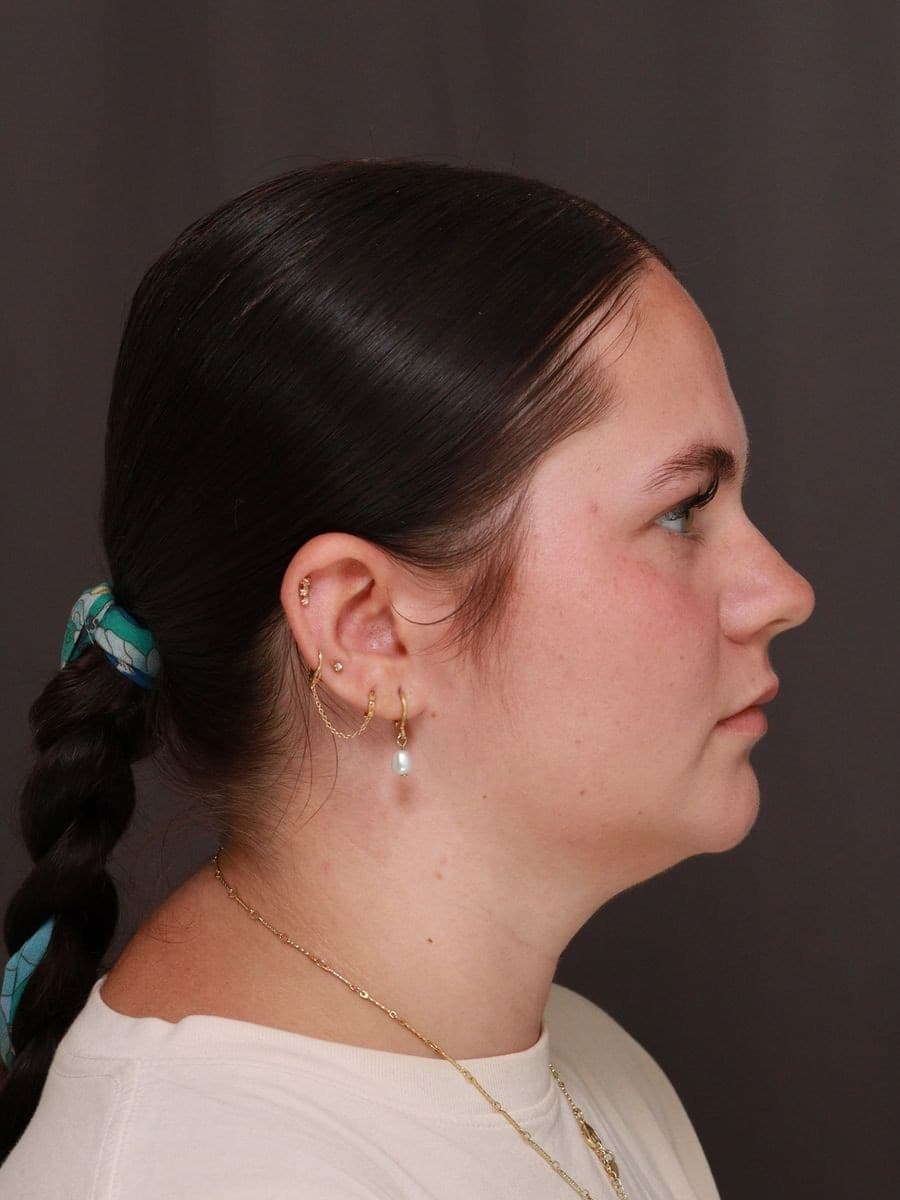
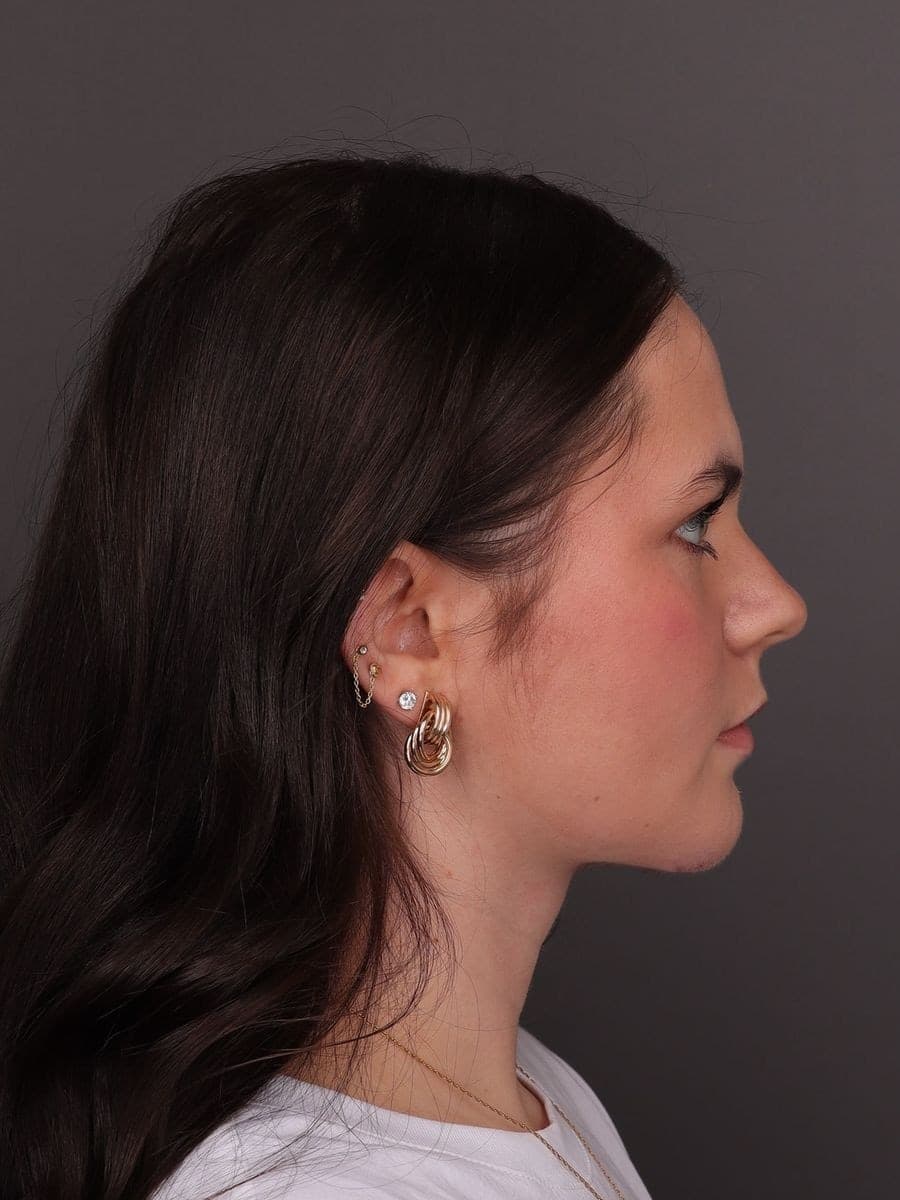
Deep neck contouring with chin implant - 6 months post-op
01 / 10
Day 0
Surgery day
Performed through a small incision under the chin. Most patients go home the same day.
Days 1–5
Head wrap around the clock
A head wrap is worn continuously, then at night only for another seven days.
Weeks 1–2
Looks fuller, briefly
The neckline often swells enough to look almost as full as before surgery. Expected — not a setback.
2–3 weeks
Growing confidence
Bruising and swelling improve significantly, and most patients start feeling confident in the result.
4–6 months
Full result
Swelling continues to resolve through three to four months, with the most significant changes visible by four to six months.
Deep neck contouring is commonly combined with a chin implant or chin pexy. Adding chin projection at the time of surgery has a synergistic effect — it balances the profile, elongates the jawline, and deepens the neck angle beyond what soft tissue contouring alone can achieve. For patients who want chin projection without an implant, a chin pexy addresses a drooping chin pad through the same incision.
For patients with skin laxity or concerns beyond the neck and jawline, a deep plane facelift may be the more appropriate procedure — or a natural next step.
Dr. James Manning is double board-certified by the American Board of Facial Plastic and Reconstructive Surgery and the American Board of Otolaryngology–Head and Neck Surgery. He specializes exclusively in the face. Deep neck contouring is one of the procedures he performs most frequently.
Medically reviewed by Dr. James Manning, MD · July 2026
Not exactly. A traditional neck lift primarily addresses skin laxity and tightens the platysma. Deep neck contouring goes further — addressing subplatysmal fat, digastric muscles, and submandibular glands through a submental incision. It is best suited for patients without significant skin laxity who want a defined neck angle and jawline.
For some patients, neck fullness has more to do with anatomy than weight. The deeper structures of the neck — fat beneath the platysma, the digastric muscles, submandibular glands, and the position of the hyoid bone — contribute to a blunted cervical angle that diet and exercise cannot change. In a published study of 152 patients undergoing deep neck surgery, subplatysmal structures accounted for 73% of the total volume removed. (O'Daniel TG. Aesthet Surg J. 2021; PMID 33543747)
For many patients, no. Liposuction addresses fat above the platysma but does not reach the deeper structures responsible for a blunted neck angle. Published surgical literature notes that tightening skin and the platysma over unaddressed subplatysmal fat, enlarged glands, and digastric muscle hypertrophy does not correct those problems. (Marten T, Elyassnia D. Facial Plast Surg. 2022; PMID 36563673)
Yes, for appropriate candidates. Deep neck contouring can be performed awake under local anesthesia or asleep under general anesthesia. There are some structures in the neck that can only be safely addressed with general anesthesia — if you want to avoid it, that conversation is worth having at consultation to clarify what is and isn't achievable.
Once the deeper tissue has been reduced, it will always be smaller than it would have been at that weight without surgery. Volume can return with significant weight gain, but the baseline has changed permanently.
Most patients have bruising and swelling for two to four weeks. Activity is restricted for three weeks. Most patients feel confident in their result around one to two months, with the most significant changes visible at four to six months.
The structural changes from deep neck contouring are lasting. Tissue that is removed does not return. The long-term appearance of the neck is influenced by weight changes and natural aging of the skin over time, but the deeper anatomy has been permanently addressed.
Maintaining a stable weight after surgery helps preserve the result. Medical-grade skin care and energy-based treatments can help maintain skin quality as the tissue continues to age.
medical-grade skin care · laser resurfacing · microneedling
Deep neck contouring addresses the neck and jawline only — it does not address skin laxity or the mid-face. For patients who develop skin laxity over time or have concerns beyond the neck, a deep plane facelift may be the appropriate next step. The two procedures are not mutually exclusive.
Deep neck contouring is performed routinely with a well-established safety profile. As with any surgical procedure, risks include temporary swelling, bruising, numbness, and asymmetry. Serious complications are uncommon. A thorough consultation — including a review of your anatomy and medical history — is the appropriate place to discuss your individual risk profile.
The cost varies from patient to patient, depending on the extent of the procedure and whether it is combined with other treatments. A $150 consultation includes a complete evaluation, and you leave with a fully transparent quote detailing every cost — surgeon's fee, facility fee, and anesthesia fee. The consultation fee is applied toward any surgery, treatment, or product.
If you have concerns about your neck that have persisted despite changes in weight or activity level, deep neck contouring may be worth discussing. We would love to see you in consultation to determine if this procedure would best fit your needs.
Inquire About Consultations801·317·8687


