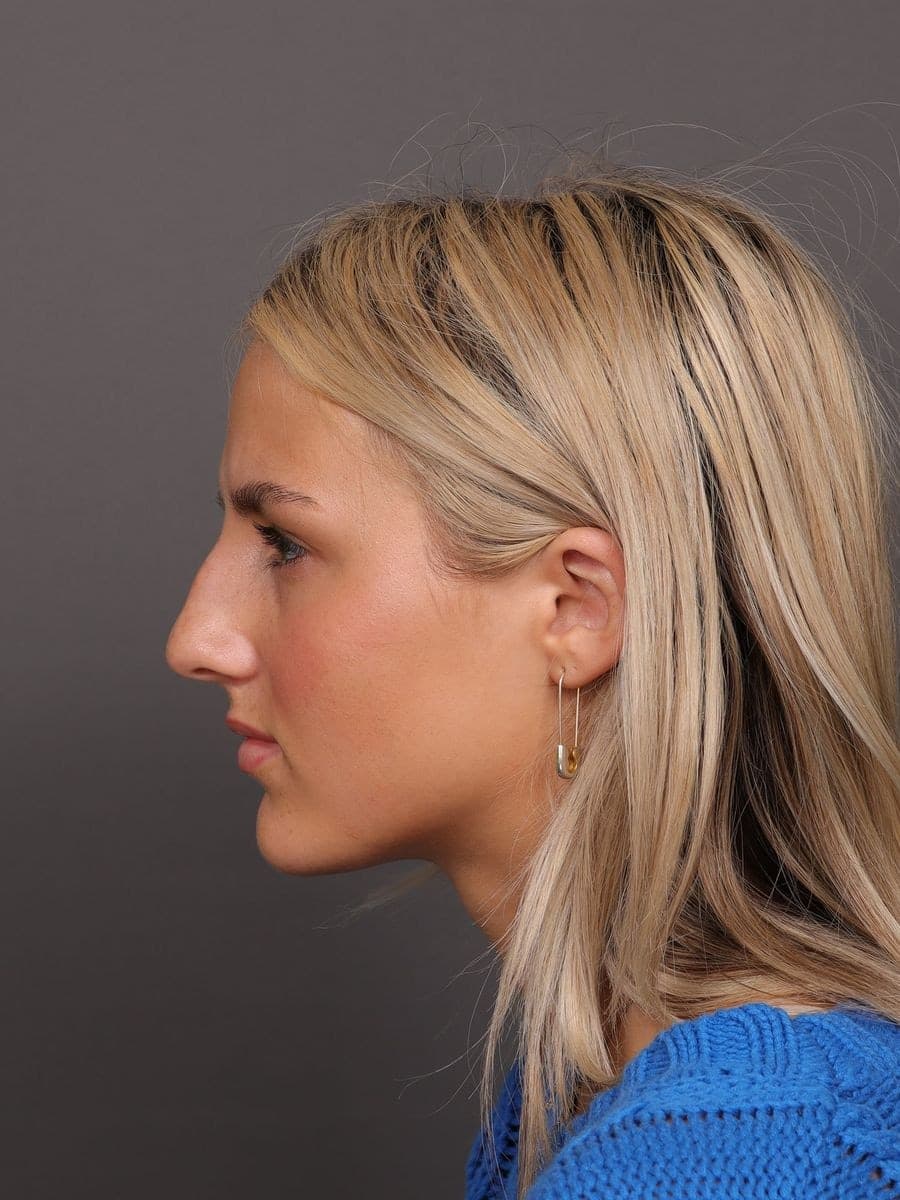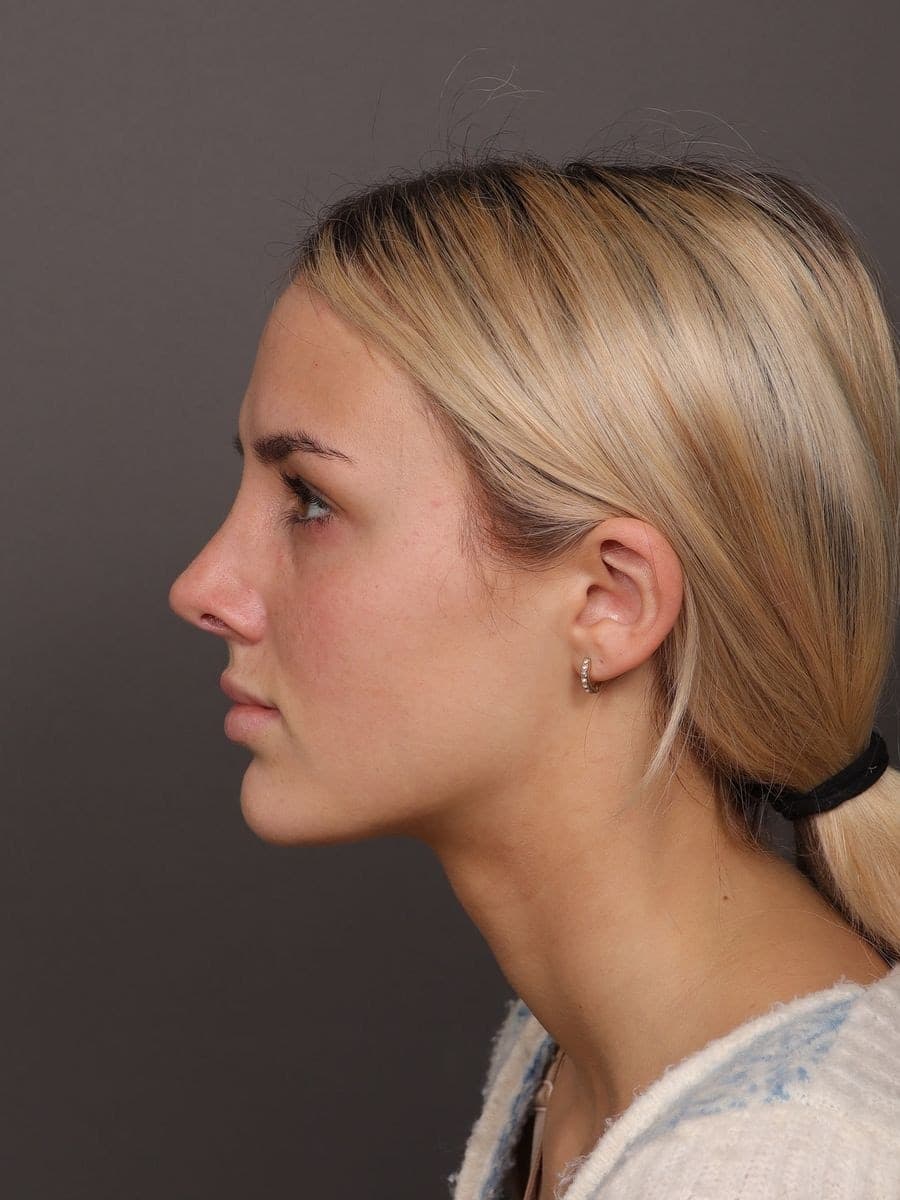
Facial plastic surgery in Salt Lake City, Utah
Insights, timelines, details, and more.
Request a ConsultationOpen rhinoplasty is an approach in which a small incision across the columella — the skin bridge between the nostrils — lets the skin be lifted off the nasal framework for direct visualization. It gives the surgeon maximal access to the lower lateral cartilages for precise reshaping, grafting, and suturing.
In practice, that single external incision changes what the surgeon can do. With the skin folded gently back, the cartilage of the tip and bridge is seen directly rather than felt through the skin. Grafts can be positioned and fixed exactly, sutures placed under direct view, and asymmetries corrected against what the eye can actually measure. Dr. James Manning performs the procedure in Salt Lake City, Utah.
Open rhinoplasty is the workhorse approach for the noses that ask the most of surgery: complex tip refinement, significant dorsal or structural change, cartilage grafting, correction of a crooked nose, and the majority of revision cases. When the change is precise or the anatomy is demanding, direct visualization is what makes it dependable.
Open rhinoplasty is a good fit when the change you are after benefits from direct access to the framework. That includes complex tip refinement, a significant reshaping of the bridge, cartilage grafting to add support or definition, and correction of a nose that is crooked or asymmetric.
It is also the usual choice for revision rhinoplasty. When a nose has been operated on before, the original framework has already been altered and the anatomy is less predictable — seeing the structures directly is what allows the surgeon to diagnose and correct what was done.
Candidates should be in good general health, have realistic expectations, and have a fully developed nose. Not every nose needs an open approach; a straightforward primary case with a mild profile concern may be better served endonasally. Which approach fits your nose is decided at the consultation.
Open and closed rhinoplasty reshape the same structures — the difference is how the surgeon reaches them. A closed, or endonasal, rhinoplasty keeps every incision inside the nose and works indirectly, which leaves no external scar and suits simpler changes. An open rhinoplasty adds one small incision across the columella so the skin can be lifted and the cartilage seen directly. It trades a tiny, well-hidden external scar for far greater precision and control — the reason it is the default for complex and revision work.
| Open | Closed | |
|---|---|---|
| Incisions | All internal, plus one small incision across the columella. | All incisions inside the nose. |
| Visualization | Skin is lifted off the framework — cartilage is seen directly. | Framework is reshaped indirectly, felt through the skin. |
| External scar | A tiny columellar scar that typically heals nearly invisibly. | None. |
| Best suited to | Complex tip work, structural change, grafting, crooked noses, revisions. | Simpler, straightforward changes in primary cases. |
| Tip swelling | Slightly longer — can take up to a year to fully settle. | Often resolves a little sooner. |
The most common hesitation about an open approach is the external incision. It is a fair question — but in practice the columellar scar is one of the more forgiving scars in facial surgery:
The tip of the nose is the hardest part to get right, and it is made of paired cartilages that are small, mobile, and rarely perfectly symmetric. Working on them through the skin means judging by feel. Lifting the skin off the framework means working by sight.
That distinction matters most exactly where rhinoplasty is most demanding. Cartilage grafts can be shaped, positioned, and fixed to a fraction of a millimeter. Sutures that define the tip are placed against what the eye measures rather than what the fingers estimate. A crooked nose can be diagnosed for what is actually deviating before anything is moved.
The trade is honest: a small columellar incision and slightly longer tip swelling in exchange for control. For the noses that need that control, it is the approach that delivers a result the surgeon can stand behind.
Day 0
Surgery day
A small incision across the columella lifts the skin off the framework for direct reshaping, grafting, and suturing. Outpatient, home the same day.
Week 1
Splint comes off
An external splint over the bridge stays on for about the first week.
Weeks 1–2
Bruising resolves
Bruising and swelling around the eyes are common and resolve on their own; most social downtime falls here.
A few weeks
Swelling drops
About eighty percent of the swelling is gone within a few weeks; the nose looks refined to people around you.
6–12 months
Final tip
Because the tip skin was lifted, tip swelling can take up to twelve months to fully settle; final definition develops over six to twelve months.
Open rhinoplasty is the platform for most nasal work, so it pairs naturally with the procedures that address the airway and the surrounding proportions. A septoplasty straightens a deviated septum and is frequently done at the same time to improve breathing while the framework is already exposed.
An alar base reduction narrows a wide nostril base through small incisions at the alar crease, and is added when the base is wide relative to the reshaped bridge and tip. For revision patients, the open approach is nearly always the starting point. A bump shave is a smaller, in-office refinement for a minor profile irregularity — a different, lesser procedure than a full open rhinoplasty.
Dr. James Manning is double board-certified by the American Board of Facial Plastic and Reconstructive Surgery and the American Board of Otolaryngology–Head and Neck Surgery. He specializes exclusively in the face. For the noses that call for precision — complex tips, structural change, grafting, crooked noses, and revisions — he uses the open approach because direct visualization is what makes those results dependable, and he reserves the closed approach for the cases that do not need it.
Medically reviewed by Dr. James Manning, MD · July 2026
Open rhinoplasty is an approach in which a small incision is made across the columella — the skin bridge between the nostrils — so the skin can be lifted off the nasal framework for direct visualization. It gives the surgeon maximal access to the lower lateral cartilages for precise reshaping, grafting, and suturing.
The difference is the incision. A closed, or endonasal, rhinoplasty keeps every incision inside the nose and reshapes the framework indirectly. An open rhinoplasty adds one small incision across the columella, which lets the skin be folded back so the surgeon can see the cartilage directly. Open trades a tiny, well-hidden external scar for far greater precision and control.
Open rhinoplasty suits cases that benefit from direct visualization: complex tip refinement, significant dorsal or structural change, cartilage grafting, correction of a crooked nose, and most revision cases where the original framework has already been altered. Candidacy is determined at consultation, after evaluating your anatomy and goals.
In most patients the columellar scar heals nearly invisibly. The incision is small and placed in a natural shadow at the narrowest part of the nose, and the columellar skin tends to heal well. It is checked at every follow-up, and in the rare case it heals less than ideally, it can usually be refined.
Most patients wear an external splint over the bridge for about a week. Bruising and swelling around the eyes are common in the first one to two weeks and resolve on their own, and most social downtime is roughly one to two weeks.
About eighty percent of the swelling is gone within a few weeks. The tip refines last — because open rhinoplasty lifts the skin off the tip, tip swelling can take up to twelve months to fully settle, and final tip definition comes into focus over six to twelve months.
The result at one month is not the final result. Patience is part of the process.
Most of the swelling — around eighty percent — resolves within the first few weeks, and by one to two months the nose looks refined to people around you. Final tip definition develops over six to twelve months, because the tip skin was lifted and takes longest to settle. The structural change made during surgery is there from the start; what changes over the year is the swelling coming down around it.
In experienced hands, open rhinoplasty has a strong safety record. It is performed under general anesthesia or IV sedation as an outpatient, same-day procedure. The small columellar incision heals reliably, and a deep knowledge of nasal anatomy is what keeps the reshaping precise and the airway protected.
The cost varies from patient to patient, depending on the extent of the reshaping and whether it is combined with other procedures. A $150 consultation includes a complete evaluation of your anatomy and goals, and you leave with a fully transparent quote detailing every cost — surgeon's fee, facility fee, and anesthesia fee. The consultation fee is applied toward any surgery, treatment, or product.
If you would like to discuss your nose, we would love to see you in consultation to determine if an open rhinoplasty would best fit your needs.
Inquire About Consultations801·317·8687