Facial plastic surgery in Salt Lake City, Utah
Insights, timelines, details, and more.
Request a ConsultationEarlobe repair is a minor in-office procedure that closes a torn, split, or stretched earlobe. The damaged or thinned edges of the piercing tract are removed, and the lobe is closed in layers so it heals as a smooth, continuous edge. It is done under local anesthesia in about 15 to 30 minutes. Dr. James Manning performs the procedure in Salt Lake City, Utah.
An earlobe repair starts with the part of the lobe that won’t heal on its own: the piercing tract. The skin lining that channel — whether it’s a fully split lobe, a partial tear, or the rim of a stretched gauge — has healed into a smooth, skin-covered surface. Two smooth surfaces will not knit together if you simply push them closed, so that lining is removed first, freshening the edges down to raw tissue that can heal.
From there it is a layered closure. Dissolvable sutures are placed in the deeper tissue layers of the lobe to take the tension off the skin, then fine sutures align the surface precisely. That two-layer approach is what keeps the edge from notching as it heals.
For a gauged or heavily stretched lobe, there is more to rebuild. Once the thinned skin is removed, the rim of the lobe is reconstructed so it has a rounded, continuous border again rather than a flat or squared-off edge.
Earlobe repair suits a few common situations. The most frequent is a lobe torn through by trauma or by years of heavy earrings, where the piercing has elongated into a slot or split all the way through the edge.
It also suits people who have stretched or gauged their lobes and want to return to a normal, closed lobe — whether the gauge was small or large. And it fits lobes where the piercing has slowly migrated outward over time, leaving an elongated hole that no longer holds an earring well.
If you are forming a keloid at the lobe — a firm, raised scar that grows beyond the original wound — that changes the plan, and it’s worth raising at consultation, because keloids are managed differently from a clean tear. Otherwise, almost any healthy adult with a torn or stretched lobe is a candidate. There is no general anesthesia and no downtime to schedule around.
Both procedures share the same first step — removing the old skin-lined tract — but they solve different problems, and that changes the operation.
| Torn Lobe | Gauged Lobe | |
|---|---|---|
| The problem | A narrow defect — the tissue is all still there; it has just separated. | A volume problem — the lobe has been thinned and elongated, so closing it isn’t enough. |
| The repair | A straight-line layered closure restores the edge cleanly. | The rim has to be rebuilt to look rounded again, often by removing the redundant skin and reconstructing the border. |
| Scar & scale | A fine line along the repair. | A slightly longer scar; occasionally staged. |
| Track record | 91% good result, with re-splitting in only about 1% of patients in a 68-lobe series over four to ten years. | A larger repair, but a reliable one for restoring a rounded rim. |
The worry I hear most is that a repaired lobe will look obviously fixed — a visible line, a notch, or a lobe that no longer matches the other side:
There is no single earlobe repair. A clean split, a partial tear, and a stretched gauge are three different problems, and a systematic review of these techniques describes at least six distinct closure methods used across them — straight-line closure, Z-plasty, local flaps, and others.
What that means in practice is simple: the right repair is the one that matches your anatomy, not a default technique applied to every lobe. A narrow split usually needs nothing more than a precise layered straight-line closure. A stretched lobe needs the rim rebuilt. Choosing between them — and deciding where any future piercing should sit — is the part that depends on looking at your specific lobe, which is what the consultation is for.
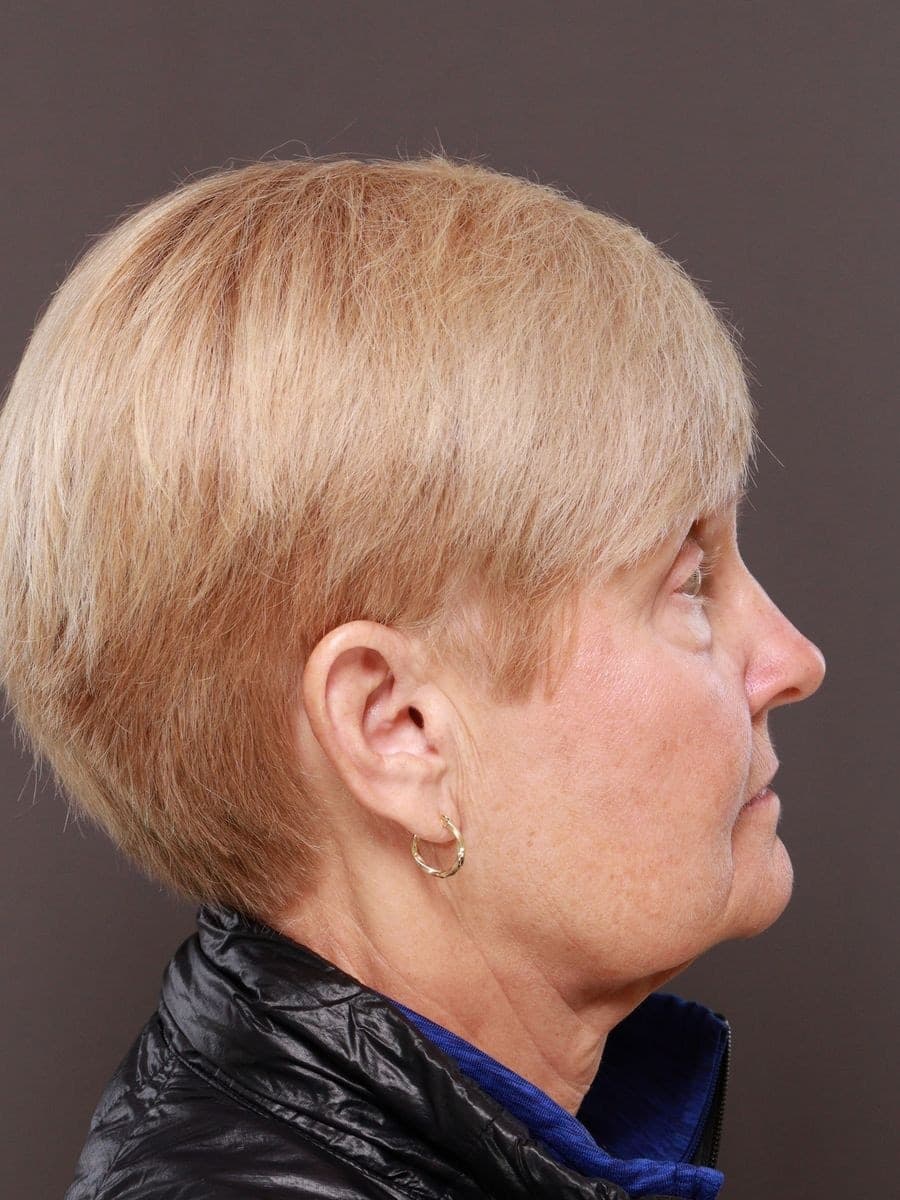
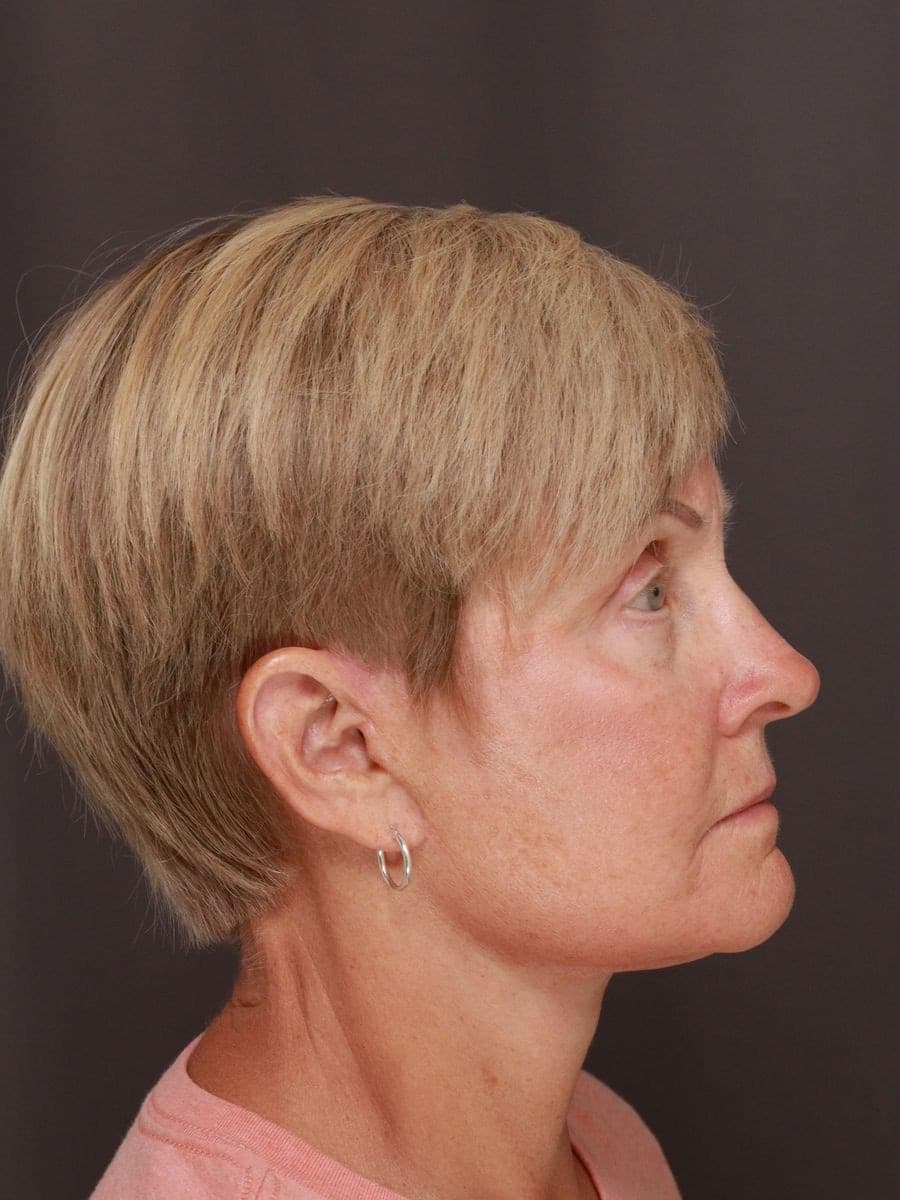
Deep plane facelift and necklift with lower blepharoplasty - 6 months post op
01 / 15
Day 0
Repair day
15 to 30 minutes, depending on whether it's a single torn lobe, both lobes, or a larger gauged-lobe reconstruction.
Days 1–3
Mild swelling
Swelling and tenderness are easily managed with over-the-counter pain relief. Most people return to normal activity right away.
~1 week
Sutures out
Surface sutures are typically removed; the deeper dissolvable sutures absorb on their own.
4–6 weeks
Fully healed
Full healing of the tissue, with the fine scar continuing to soften.
~6 weeks
Re-piercing OK
Once the lobe has strengthened enough to hold an earring, placed slightly away from the scar.
Earlobe repair is often done on its own, but a few procedures pair naturally with it.
Both lobes are commonly repaired in the same visit when both are torn or stretched. Earlobe repair also pairs with earlobe reduction for patients whose lobes have lengthened with age, and with a lobe filler approach for thin, deflated lobes that don’t need surgical closure but have lost their cushion. For patients addressing the face more broadly, it’s a small add-on that’s easily combined with an in-office visit for other minor procedures.
Dr. James Manning is a double board-certified facial plastic surgeon, certified by the American Board of Facial Plastic and Reconstructive Surgery and the American Board of Otolaryngology–Head and Neck Surgery. He specializes exclusively in the face, supported by an ongoing commitment to continued learning and the refinement of technique. Even on a procedure as small as an earlobe repair, his goal is the same: a result that is undetectable and that lasts.
Medically reviewed by Dr. James Manning, MD · July 2026
Earlobe repair is a minor in-office procedure that closes a torn, split, or stretched earlobe. The skin-lined edges of the old piercing tract are removed and the lobe is closed in layers so it heals as a smooth, continuous edge. It is performed under local anesthesia in about 15 to 30 minutes.
Yes. A torn or split lobe is usually closed with a straight-line layered repair, because the tissue is all still present and just separated. A gauged or stretched lobe has been thinned and elongated, so the rim has to be reconstructed, not just closed — a larger repair with a slightly longer scar that is occasionally staged.
The lobe is numbed with a local anesthetic before the repair, so you won't feel the procedure itself — only some tugging and pressure. Afterward there is usually mild tenderness for a few days, which over-the-counter pain relief handles well.
No. Earlobe repair is performed in the clinic under local anesthesia. Because you are awake and not sedated, you can drive yourself to and from the appointment.
Surface sutures are typically removed about one week after the repair, and the deeper dissolvable sutures absorb on their own. The fine scar continues to soften over the following weeks, with full tissue healing taking roughly four to six weeks.
Dr. Manning generally advises waiting about six weeks after the repair before re-piercing, once the lobe has healed enough to hold an earring without re-tearing. The new piercing is usually placed slightly away from the repair, in strong tissue.
There is a fine scar along the line of the repair, but the layered closure is designed to keep the lower edge from notching, which is what most people notice. The scar typically softens and becomes difficult to see as it matures, and the repaired lobe is matched as closely as possible to the other side.
The goal is modest on purpose — restore a normal lobe contour matched as closely as possible to your other lobe, not reshape the ear. The layered closure keeps the lower edge from notching, which is the giveaway most people want to avoid, and the fine scar typically becomes hard to pick out as it settles.
Yes. Once the tract is removed and the lobe heals, the repair is permanent. In a published series of 68 torn lobes, re-splitting occurred in only about 1% of patients over four to ten years.
An earlobe repair is permanent in the sense that matters most: once the tract is removed and the lobe heals, the repair is part of the lobe — it does not loosen or reverse over time. In the torn-lobe series above, re-splitting occurred in only about 1% of patients across four to ten years of follow-up.
What can undo a good repair is repeating what caused the damage. A lobe that re-tears almost always does so for the same reasons as the first time: re-piercing too soon, very heavy earrings, or an earring catching and pulling through. The repaired tissue is strong, but a fresh re-piercing through it is not, until it heals.
So the longevity is really in your hands after the repair. Wait the full re-piercing window, keep heavy or dangling earrings off a freshly re-pierced lobe, and the repair lasts indefinitely.
A keloid is a firm, raised scar that grows beyond the original wound, and it is managed differently from a clean tear. Surgical removal of an earlobe keloid on its own has a high recurrence rate, but pairing the excision with measures such as postoperative steroid injections substantially lowers the chance of it returning. Raise it at your consultation so the plan accounts for it.
Cost depends on whether it's one lobe, both lobes, or a larger gauged-lobe reconstruction. A $150 consultation includes a complete evaluation, and you leave with a fully transparent quote for the repair. The consultation fee is applied toward any surgery, treatment, or product.
We would love to see you in consultation to determine which earlobe repair would best fit your lobe.
Inquire About Consultations801·317·8687