Follicular unit transplantation in Salt Lake City, Utah
Insights, timelines, details, and more.
Request a ConsultationFUT — follicular unit transplantation, the strip method — is a hair transplant technique that removes a thin strip of skin from the permanent donor zone at the back of the scalp. The strip is dissected under magnification into individual follicular units, which are transplanted into the thinning areas. The donor site is closed with a fine sutured line. Dr. James Manning performs the procedure in Salt Lake City, Utah.
Because the whole donor supply is harvested in a single strip, FUT can yield the most grafts of any technique in one session — and it does not require shaving the donor area, so the surrounding hair lies over the closure and hides it. What FUT leaves behind is a single fine linear scar, concealed by the hair above it.
Recipient sites — the small incisions that determine where each graft sits and at what angle — are created by hand by Dr. Manning, one site at a time. This is the most technically demanding step and the one most directly responsible for the direction, density, and hairline design of the final result. The dissected follicular units are then placed into those sites, producing a permanent result when graft survival is maintained through careful handling.
FUT is a strong fit for patients with large areas of loss who want the maximum number of grafts in a single session. When recession extends deep into the crown or across the whole top of the scalp, the strip method can move more grafts at once than extracting them one at a time.
Because FUT leaves a fine linear donor line, the best candidates keep their hair long enough at the back and sides to cover it. It is also the technique of choice for revision work — the strip can often be taken through a prior scar, consolidating rather than adding new donor disruption — and for cases where maximizing graft yield matters most.
A thorough donor assessment at consultation determines graft availability and sets the scope of what is possible. Progressive loss that is not yet stable is managed medically before or alongside surgery, and vitamin deficiencies or thyroid dysfunction — often overlooked contributors — are identified and addressed first.
FUT (follicular unit transplantation) and FUE (follicular unit extraction) differ only in how the grafts are harvested; once placed, both grow permanently and look natural. FUT removes one strip of donor tissue, so it can yield the most grafts in a single session and does not require shaving the donor area — the trade-off is a single fine linear scar that the surrounding hair conceals.
FUE removes follicular units one at a time and leaves no linear scar, making it a good fit for patients who wear their hair short. It covers less ground per session and requires the donor area to be clipped. The right choice depends on how much coverage you need, how you wear your hair, and your donor supply — decided together at consultation.
| FUT | FUE | |
|---|---|---|
| How grafts are harvested | Removed as one strip of donor tissue, then dissected under magnification into individual units. | Removed one at a time with a small punch. |
| Grafts per session | The most grafts of any technique in a single session. | Fewer grafts per session; larger goals may need more visits. |
| Donor area | Not shaved — surrounding hair hides the closure; leaves a fine linear scar. | Clipped short for harvest; no linear scar. |
| Best suited to | Large areas of loss, maximum graft counts, and revision work; patients who keep some length. | Patients who wear their hair short and want to keep that option. |
The linear donor scar is the concern patients raise most often about FUT — and in practice it is far less visible than expected:
Dr. Manning trained under a technician with 30 years of experience in hair restoration — spending a full year focused on the procedure before performing it independently. He performs a significant portion of each transplant himself, including recipient site creation by hand, one site at a time. Many surgeons delegate this work entirely.
In FUT that judgment matters at both ends of the procedure: a fine, tension-free donor closure that heals to a concealable line, and recipient sites angled to place the maximum single-session graft yield where it counts. Dr. Manning performs two to three hair transplants per week — it is one of his primary areas of focus, not an ancillary offering.
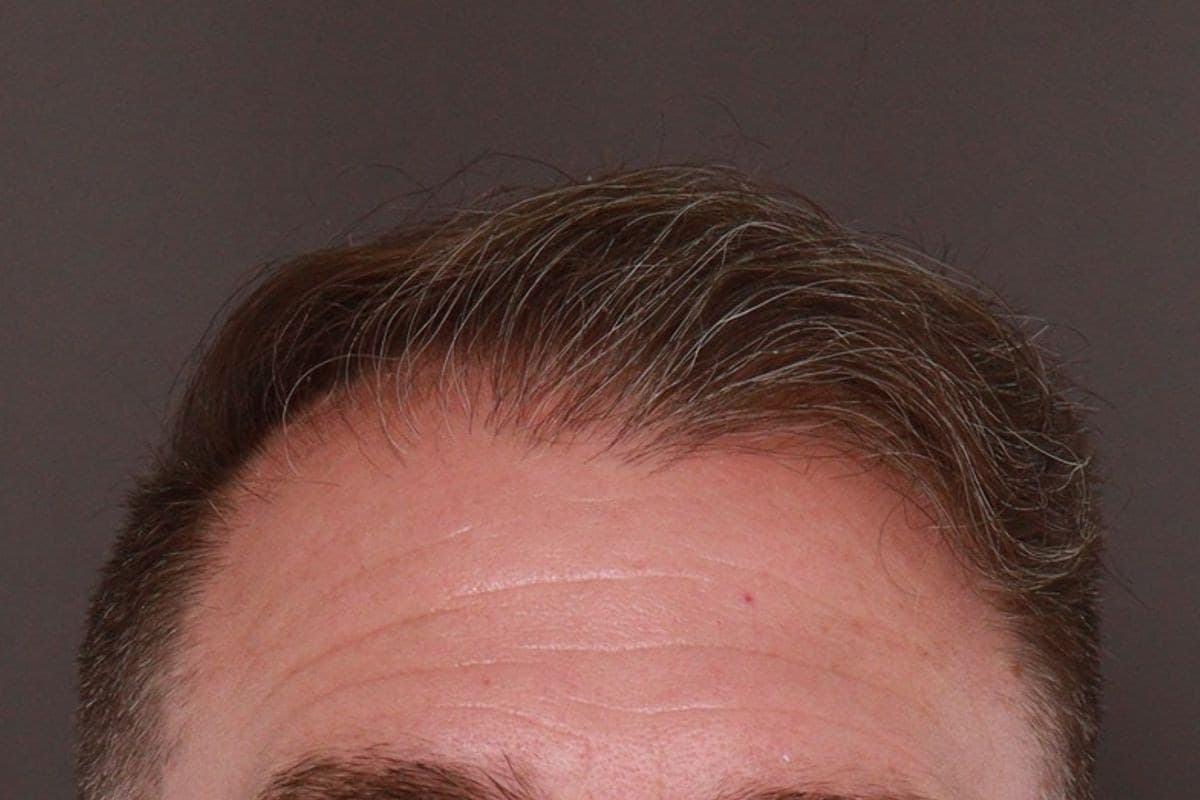
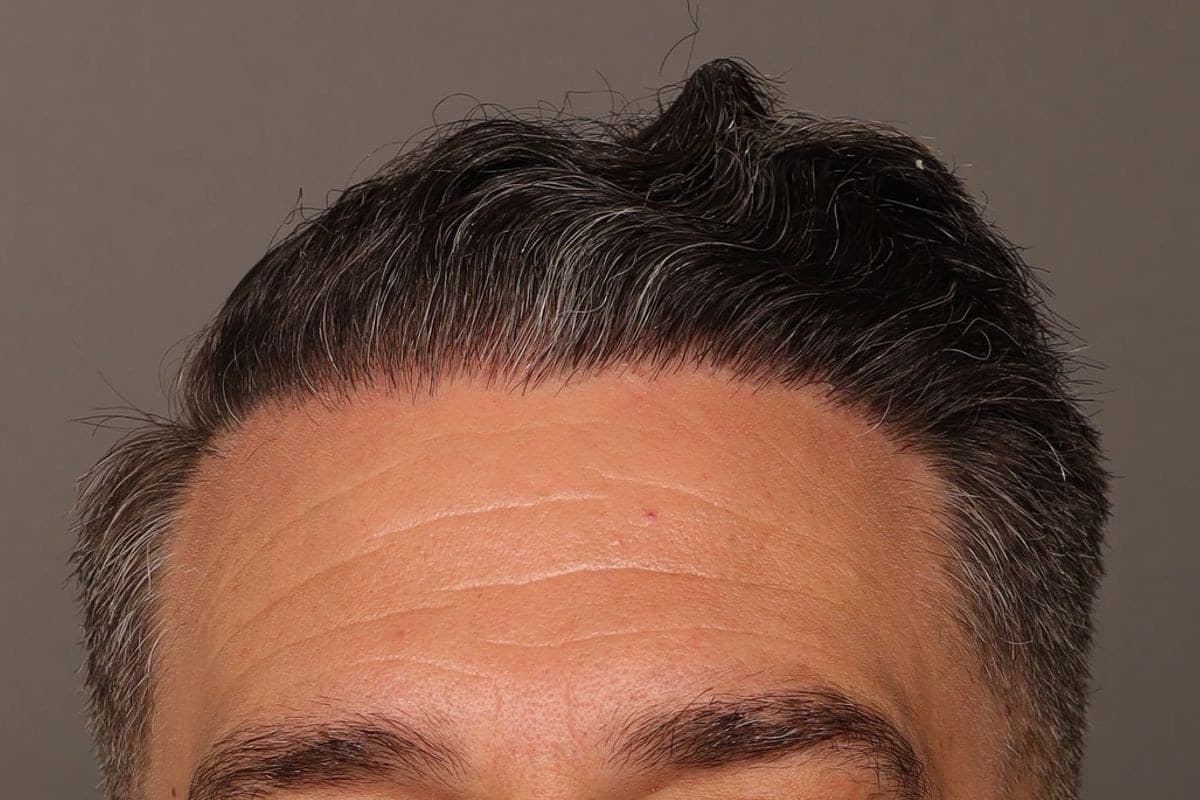
FUE Transplant focused on the frontal scalp and vertex - 2 years post-op
01 / 04
5–7 days
Crusts shed
The small crusts at the recipient sites shed over the first five to seven days.
10–14 days
Sutures out
Sutures or staples in the donor line are removed around ten to fourteen days.
2–4 wks
Expected shedding
The transplanted hairs shed. This is expected and does not indicate graft failure.
3–4 mos
Growth starts
Regrowth begins and continues to thicken through the following months. The donor line matures and fades.
9–18 mos
Final result
Meaningful density by nine to twelve months; the final result matures at twelve to eighteen months.
Nonsurgical treatments pair well with FUT as ongoing maintenance. Prescription oral medications and, where appropriate, bioidentical hormone therapy address the hormonal drivers of loss, while topical treatments support follicular health. Correcting underlying vitamin deficiencies and thyroid dysfunction — often overlooked contributors to hair loss — protects the native hair surgery cannot reach.
For patients seeking a more comprehensive change in facial framing, FUT pairs well with hairline lowering surgery — also called forehead reduction — and with eyebrow or facial hair restoration, where the strip method’s high graft yield is an advantage.
Dr. James Manning is double board-certified by the American Board of Facial Plastic and Reconstructive Surgery and the American Board of Otolaryngology–Head and Neck Surgery. He specializes exclusively in the face.
Dr. Manning trained under a technician with 30 years of experience in hair restoration — spending a full year focused on the procedure before performing it independently. He performs a significant portion of each transplant himself, including the donor closure and recipient site creation by hand, one site at a time. Many surgeons delegate this work entirely.
Dr. Manning performs two to three hair transplants per week. It is one of his primary areas of focus — not an ancillary offering.
Medically reviewed by Dr. James Manning, MD · July 2026
FUT — follicular unit transplantation, also called the strip method — removes a thin strip of skin from the permanent donor zone at the back of the scalp. Under magnification, that strip is dissected into individual follicular units, which are then transplanted into the thinning areas. The donor site is closed with a fine sutured line that the surrounding hair covers.
The difference is only in how the grafts are harvested. FUT removes one strip of donor tissue in a single pass, which lets it yield the most grafts in one session and does not require shaving the donor area. FUE removes follicular units one at a time and leaves no linear scar, but covers less ground per session. Once the grafts are placed, both techniques produce the same permanent, natural-growing result.
FUT suits patients with large areas of loss who want the maximum number of grafts in a single session, and who keep their hair long enough at the back and sides to cover a fine linear donor line. It is also well suited to revision work, because the strip can often be taken through a prior scar rather than adding new donor disruption. A donor assessment at consultation confirms whether FUT or FUE is the better fit.
FUT leaves a single fine linear scar in the donor zone at the back of the scalp. Because the donor area is not shaved, the surrounding hair lies over the closure and hides it in everyday wear — most patients cannot see it once healed. The line is visible only if the hair around it is clipped very short, so FUT is best for patients who keep some length at the back and sides.
FUT is an outpatient procedure under local anesthesia, and most patients return to desk work within a few days. Sutures or staples in the donor line are removed around ten to fourteen days, and the small crusts at the recipient sites shed over the first five to seven days. Strenuous activity and direct sun on the scalp are avoided for two to three weeks while the donor line settles.
The transplanted hairs shed at two to four weeks — this is expected and does not mean the grafts failed. Regrowth begins at three to four months, meaningful density arrives by nine to twelve months, and the final result matures at twelve to eighteen months. The donor line itself continues to mature and fade over the several months after surgery.
The follicular units used in FUT are taken from the permanent donor zone at the back and sides of the scalp — hair that is genetically resistant to the hormonal changes that cause pattern baldness. Once transplanted, those grafts keep that resistance and grow for life.
Native hair outside the transplanted zone can continue to thin over time, which is why nonsurgical management remains part of the long-term plan. Protecting the surrounding hair preserves the overall result and can reduce the need for additional sessions.
For patients with progressive loss, a second session may be appropriate in the future — either to address new areas of recession or to add density to a prior zone. But the grafts placed in an FUT session are there to stay.
FUT is performed in the office setting under local anesthesia. A thin strip of donor skin is harvested from the back of the scalp and the donor site is closed with a fine sutured line. The strip is then dissected under microscopic magnification into individual follicular units, while Dr. Manning creates the recipient sites by hand, one at a time, to set the angle, direction, and density of the result before the grafts are placed.
The cost varies from patient to patient, depending on the number of grafts and whether FUT is combined with other treatments. A $150 consultation includes a complete donor assessment, and you leave with a fully transparent quote detailing every cost. The consultation fee is applied toward any surgery, treatment, or product.
If you are considering FUT and want to understand what’s possible for your donor supply and pattern of loss, we’d love to see you in consultation.
Inquire About Consultations801·317·8687


