
Facial plastic surgery in Salt Lake City, Utah
Insights, timelines, details, and more.
Request a ConsultationForehead reduction — also called hairline lowering or scalp advancement — is a surgical procedure that shortens a tall forehead by advancing the hair-bearing scalp forward. An incision is made along the hairline, excess forehead skin is removed, and the scalp is moved down to set a lower hairline. The hairline typically lowers by about 1.5 to 2.5 centimeters in one stage. Dr. James Manning performs the procedure in Salt Lake City, Utah.
Forehead reduction begins with an incision along the front of the hairline — either pretrichial (just in front of the hairline) or trichophytic, an irregular incision placed slightly behind the hairline so hair grows through and camouflages the scar. The forehead skin is released, the scalp behind the hairline is freed and advanced forward, and the strip of excess forehead skin between the new and old hairline positions is removed.
The advanced scalp is then secured and the incision is closed so the hairline sits lower on the face. Most patients gain about 1.5 to 2.5 centimeters of advancement in a single stage; larger moves may need tissue expansion or a second stage. Scalp laxity — how mobile the scalp is — sets the ceiling on how far the hairline can come forward.
Good candidates for forehead reduction have a high or tall forehead, good scalp laxity, and a stable hairline that is not receding. The procedure suits a lifelong high hairline far better than one driven by progressive hair loss — advancement assumes the hairline will stay where it is placed.
Candidacy is set largely by the scalp. A mobile scalp allows more advancement in a single stage; a tight scalp limits the move or shifts the plan toward staging or transplantation. Forehead reduction is often combined with a brow lift, since both work through an incision near the hairline and address the upper third of the face together. A consultation with scalp-laxity assessment determines what is realistic for your anatomy.
A hair transplant lowers a high hairline by moving follicles one graft at a time, building a new hairline in front of the old one. Forehead reduction moves the existing hairline forward in one stage, delivering full native density immediately — a result a transplant reaches only after multiple sessions and a year of growth.
| Forehead Reduction | Hair Transplant | |
|---|---|---|
| Mechanism | Advances the existing hair-bearing scalp forward in one stage. | Moves follicles one graft at a time to build a new hairline. |
| Best suited to | A high or tall forehead with good scalp laxity and a stable, non-receding hairline. | A tight scalp, a receding hairline, or reshaping the hairline itself. |
| Density & timeline | Full native density immediately, in a single stage. | Added gradually, growing in over months. |
| The result | Advancement is typically the more direct way to shorten the forehead when candidacy allows it. | Adds density or reshapes the hairline where advancement cannot reach. |
The concern with forehead reduction is a visible scar across the hairline or a hairline that looks drawn-on. Both are addressed by technique:
Dr. Manning plans forehead reduction around two measurements that decide the outcome: how much scalp laxity is available and where the lowered hairline should sit for the patient’s facial proportions.
The incision is designed to camouflage — trichophytic where it serves the hairline — and the advancement is taken to what the scalp will safely allow in one stage rather than forced.
Because he treats the upper third of the face as a unit, Dr. Manning frequently combines forehead reduction with a brow lift in the same setting when both are indicated. He specializes exclusively in the face, and hairline work sits inside a broader hair-restoration practice.
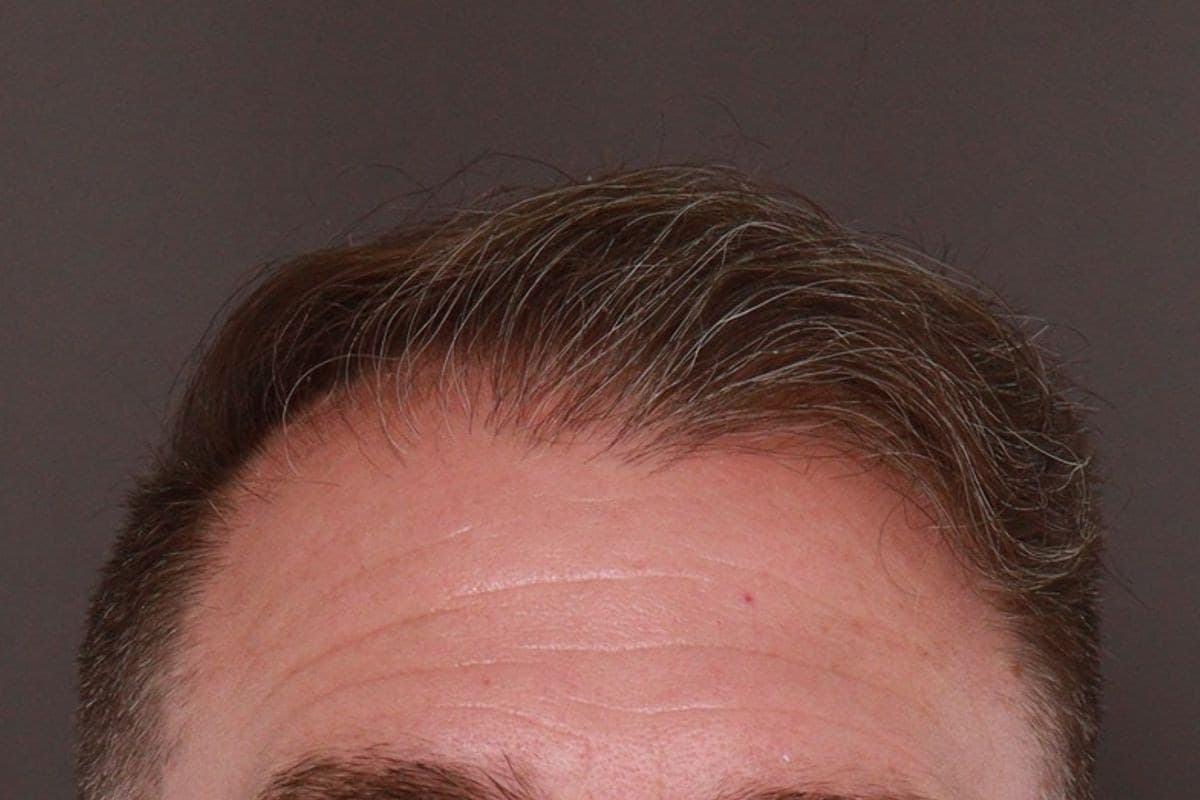
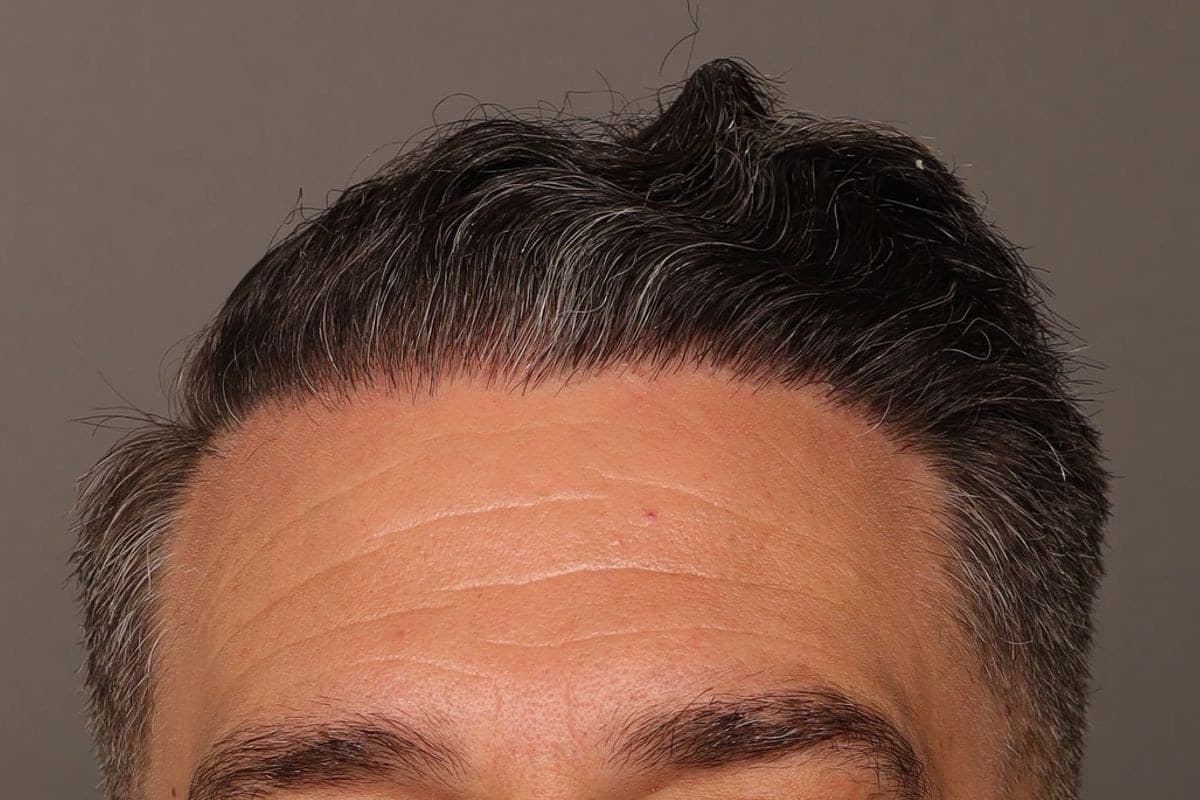
FUE Transplant focused on the frontal scalp and vertex - 2 years post-op
01 / 04
Day 0
Surgery day
The hairline is advanced and the incision closed, then home the same day.
Days 1–7
Early swelling
Swelling across the forehead and around the eyes is common and may track downward before it resolves.
Days 7–10
Sutures out
Sutures or staples along the hairline typically come out at about 7 to 10 days.
1–2 weeks
Back to desk work
Most patients return to desk work within roughly one to two weeks, once the early swelling settles.
Weeks–months
Scar matures
Scalp numbness resolves and the trichophytic scar fades as hair grows through the closure.
Forehead reduction is most often combined with a brow lift, since both are addressed through an incision near the hairline and together rebalance the upper third of the face.
For patients whose scalp laxity limits how far the hairline can advance, a hair transplant can add density or refine the hairline shape that advancement alone cannot reach. Non-surgical hair restoration protects the native hairline against future recession.
Dr. James Manning is double board-certified by the American Board of Facial Plastic and Reconstructive Surgery and the American Board of Otolaryngology–Head and Neck Surgery. He specializes exclusively in the face.
Forehead reduction is a procedure where incision design and hairline planning determine whether the result looks natural — Dr. Manning designs the closure to camouflage and shapes the hairline to the patient’s proportions rather than a template, and combines it with a brow lift when both are indicated.
Medically reviewed by Dr. James Manning, MD · July 2026
Forehead reduction — also called hairline lowering or scalp advancement — is a surgical procedure that shortens a tall forehead by advancing the hair-bearing scalp forward. An incision is made along the hairline, a strip of excess forehead skin is removed, and the scalp is secured in a lower position. The hairline typically lowers by about 1.5 to 2.5 centimeters in a single stage.
The hairline is usually advanced by about 1.5 to 2.5 centimeters in one stage, with the exact amount set by how mobile the scalp is. In a published series of 91 hairline-lowering patients, the hairline was advanced an average of about 18 millimeters, and all patients reported being satisfied or very satisfied with the result. (Min JH et al. Aesthet Surg J. 2019;39(5):NP97-NP105. PMID 30380006)
A trichophytic incision is placed so that hair grows through the closure and camouflages the scar, and the scar matures and fades over several months. In a review of 641 forehead reduction patients, both patients and independent surgeons rated the resulting scar favorably on standardized scales. (Lee SH et al. Aesthetic Plast Surg. 2021;45(4):1551-1560. PMID 33683382)
They solve the problem differently. Forehead reduction advances existing hair in one stage and gives full native density immediately, but requires good scalp laxity and a stable hairline. A hair transplant builds a new hairline graft by graft over months and suits patients with a tight scalp or a receding hairline. As an alternative to transplantation for an overly high hairline, hairline-lowering surgery offers immediate results and high density in appropriately selected candidates. (Epstein J, Epstein GK. Facial Plast Surg Clin North Am. 2020;28(2):197-203. PMID 32312507)
Good candidates have a high or tall forehead, good scalp laxity, and a stable, non-receding hairline. A mobile scalp allows more advancement in one stage. Because advancement assumes the hairline will stay where it is placed, the procedure suits a lifelong high hairline better than one driven by progressive hair loss. (Epstein J, Epstein GK. Facial Plast Surg Clin North Am. 2020;28(2):197-203. PMID 32312507)
Yes. Forehead reduction and a brow lift both work through an incision near the hairline and together address the upper third of the face, so they are frequently performed in the same setting when both are indicated.
Sutures or staples along the hairline typically come out at about 7 to 10 days, and most patients return to desk work within roughly one to two weeks. Swelling settles over the first several days, and temporary numbness of the scalp behind the incision usually resolves over weeks to months.
Forehead reduction is permanent. Once the scalp is advanced and healed, the hairline stays at its new, lower position — the skin does not migrate back up. The shortened forehead is a lasting structural change.
What surgery does not stop is androgenetic hair loss. A native hairline can still recede over time from hormonal thinning, independent of where it was surgically set. This is why candidacy favors a stable, non-receding hairline, and why some patients pair advancement with non-surgical hair management — DHT-blocking medication and topical therapy — to protect the hairline going forward.
Yes. The scalp is advanced and healed into a lower position and does not migrate back up, so the shortened forehead is permanent. Surgery does not stop androgenetic hair loss, however, so a native hairline can still thin or recede over time — which is why candidacy favors a stable hairline.
Forehead reduction is performed under anesthesia, so the surgery itself is not felt. Afterward, most patients report tightness and mild-to-moderate soreness across the forehead and scalp that is managed with medication and eases over the first several days.
If you are considering forehead reduction, we’d love to see you in consultation to determine if forehead reduction is the right fit for your anatomy and goals.
Inquire About Consultations801·317·8687


