Facial plastic surgery in Salt Lake City, Utah
Insights, timelines, details, and more.
Request a ConsultationAn eyebrow transplant restores or reshapes the brows by relocating individual follicular units — usually single hairs taken from the scalp donor area — into the brow, with each hair placed at the precise angle and direction natural brow growth follows. It suits brows thinned by over-plucking, scarring, alopecia, or trauma. Dr. James Manning performs the procedure in Salt Lake City, Utah.
Donor hair is harvested from the scalp — typically the back or sides of the head, where hair is genetically resistant to loss — using either follicular unit extraction (FUE), which removes grafts one at a time, or follicular unit transplantation (FUT), which takes a small strip of donor tissue. For the brow, grafts are almost always divided down to single hairs, because brow hairs grow individually rather than in the clusters of two to four found on the scalp.
The procedure is performed under local anesthesia on an outpatient basis. A session typically places a few hundred grafts per brow, depending on your goals. Each recipient site is created by hand, one at a time, and each graft is set at the angle and direction that will read as a natural brow — the step most directly responsible for the final result.
An eyebrow transplant is a good fit if your brows are thin, patchy, or absent — whether from years of over-plucking, scarring, burns, trauma, or alopecia. It is equally suited to patients who simply want fuller, better-defined brows, because the procedure both restores lost hair and reshapes the brow.
The main requirement is sufficient scalp donor density. A donor assessment at consultation confirms there is enough healthy hair to harvest and sets the scope of what’s possible. Realistic expectations matter too: the goal is a natural, proportioned brow, not an artificially dense one.
Where hair loss is active or a scarring form of alopecia is suspected, that is evaluated first — occasionally medical management or a different plan is the right call before transplantation. When the underlying cause is stable, the transplanted grafts are permanent.
A transplant and microblading solve the same complaint — thin or absent brows — in fundamentally different ways. A transplant relocates your own living hair, which grows permanently. Microblading is a cosmetic tattoo: pigment deposited in the skin that fades over time and needs redoing. They are not better and worse, but different, and the two can even be combined.
| Transplant | Microblading | |
|---|---|---|
| What it is | Your own living hair follicles, relocated from the scalp and growing in the brow. | Pigment tattooed into the skin to imitate the look of hair. |
| How long it lasts | Permanent — the transplanted follicles grow for life. | Semi-permanent; fades over one to three years and needs touch-ups. |
| Texture & dimension | Real three-dimensional hair you can brush, shape, and — because it is scalp hair — must trim. | Flat pigment on the skin’s surface; no true texture. |
| The result | A restored brow that behaves like your own hair, when grafts are angled by hand. | A convincing near-term appearance that requires ongoing maintenance. |
The defining challenge of an eyebrow transplant is not surgical — it is aesthetic. A natural brow depends on getting a few details exactly right:
An eyebrow is a small canvas where every hair is visible, so there is nowhere to hide an imprecise angle. Dr. Manning designs the brow shape to the individual face, then creates each recipient site by hand — controlling the angle, direction, and spacing of every graft, one at a time.
That control is what separates a natural brow from an obvious one. Because he performs a significant portion of each procedure himself, the surgeon’s judgment drives the outcome at the step that matters most — the placement — rather than being handed off.
Hair restoration is one of Dr. Manning’s primary areas of focus. He trained for a full year under a technician with three decades of experience before performing this work independently.
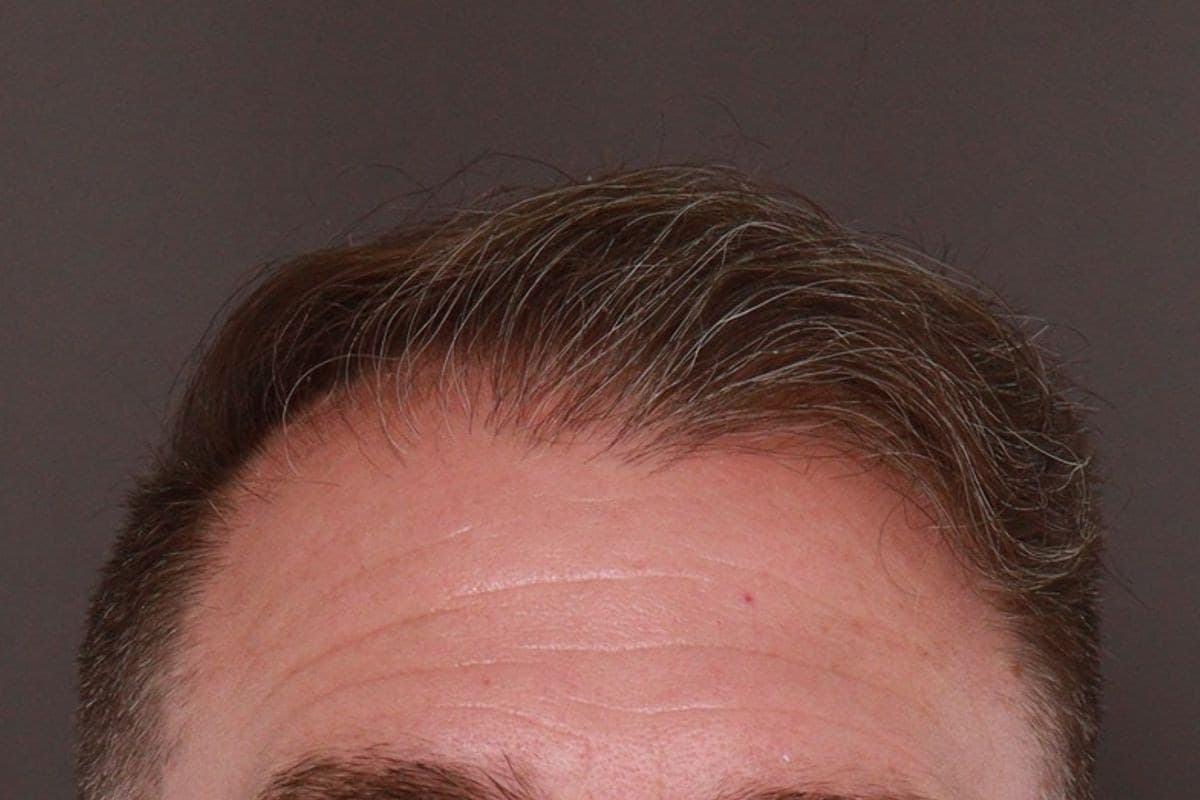
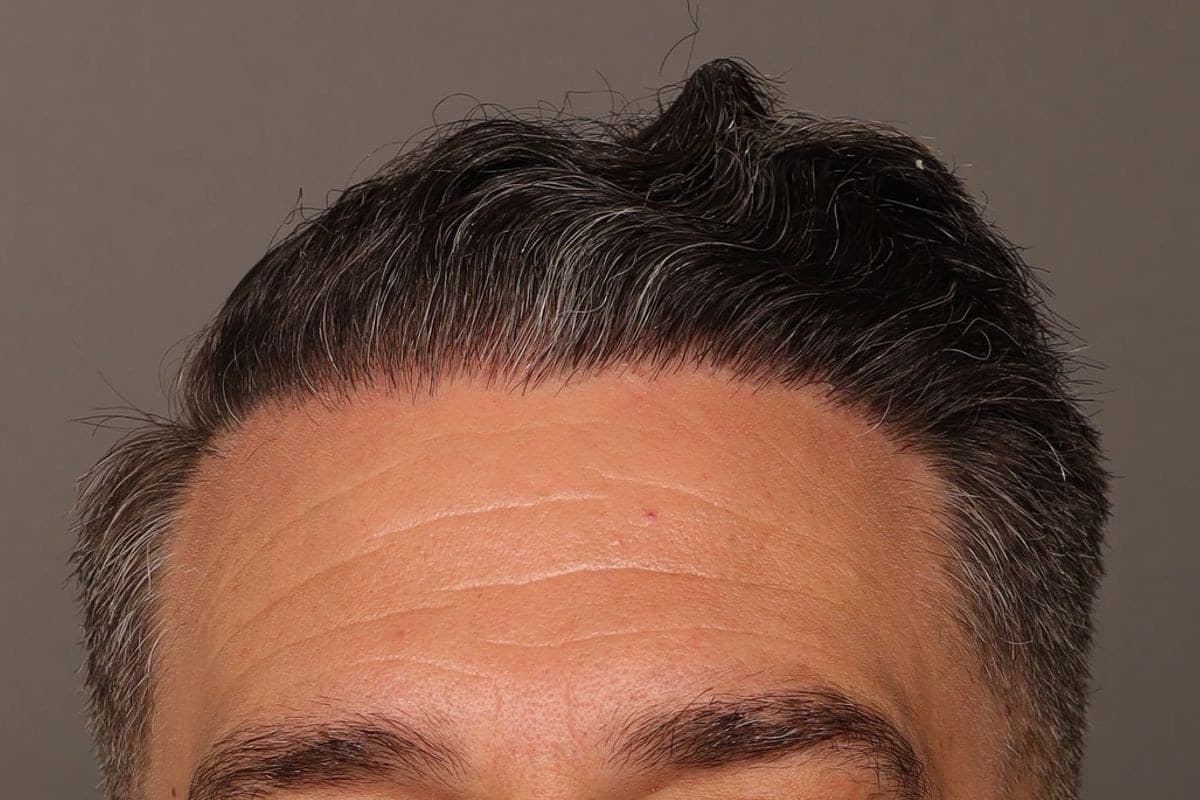
FUE Transplant focused on the frontal scalp and vertex - 2 years post-op
01 / 04
Days 5–7
Crusts shed
Tiny crusts around each graft form and shed over the first five to seven days. Most patients return to normal activity within a day or two.
2–4 wks
Expected shedding
The transplanted hairs shed. This is expected and does not indicate graft failure — the follicles remain and cycle into a rest phase.
~3 mos
Regrowth begins
New growth begins from the transplanted follicles and continues to thicken over the following months.
6–9 mos
Shape matures
The brow shape fills in and matures, with density and definition still improving.
~12 mos
Final result
The final result is visible at about one year — permanent, and growing like the scalp hair it came from.
An eyebrow transplant uses the same follicular-unit techniques as a scalp hair transplant, so it pairs naturally with the rest of the hair-restoration program. Patients addressing hairline or crown loss can combine brow work with a scalp transplant, harvesting from the same donor area.
Facial hair transplant — beard, mustache, or sideburn restoration — applies the same single-hair artistry to other areas of the face. Non-surgical hair restoration supports the health of native hair around any transplanted zone.
Dr. James Manning is double board-certified by the American Board of Facial Plastic and Reconstructive Surgery and the American Board of Otolaryngology–Head and Neck Surgery. He specializes exclusively in the face.
Hair restoration is one of his primary areas of focus. Dr. Manning trained under a technician with 30 years of experience — spending a full year focused on the procedure before performing it independently — and performs a significant portion of each transplant himself, including recipient-site creation by hand, one site at a time. On a brow, where every hair is visible, that hands-on control is what produces a natural result.
Medically reviewed by Dr. James Manning, MD · July 2026
An eyebrow transplant restores or reshapes the brows by relocating individual follicular units — usually single hairs taken from the scalp donor area — into the brow. Each hair is placed at the precise angle and direction that natural brow growth follows. It suits brows thinned by over-plucking, scarring, alopecia, or trauma.
The donor hair is taken from your own scalp, typically the back or sides of the head, where hair is genetically resistant to loss. It is harvested by FUE (individual follicular units removed one at a time) or FUT (a small strip of donor tissue dissected into individual units). For the brow, grafts are almost always divided down to single hairs, because brow hairs grow individually rather than in the clusters of two to four found on the scalp.
Good candidates have brows that are thin, patchy, or absent from over-plucking, scarring, alopecia, burns, or trauma, along with sufficient scalp donor density and realistic expectations. The procedure both restores lost hair and reshapes the brow, so it also suits patients who simply want fuller, better-defined brows. A donor assessment at consultation confirms candidacy.
Natural results depend almost entirely on artistry. Brow hairs lie nearly flat against the skin and change direction across the brow — angling upward at the inner head, then sweeping outward along the arch and tail. Dr. Manning designs the brow shape and places every graft by hand at the angle and direction that mimics that natural growth pattern, one hair at a time.
Yes. Because the donor hair comes from the scalp, it keeps the growth characteristics of scalp hair — meaning transplanted brows continue to grow longer than native brow hair and need to be trimmed periodically, usually every few weeks. Over time many patients find the hairs soften and behave more like brow hair, but regular trimming remains part of maintaining the result.
The procedure is outpatient under local anesthesia, and most patients return to normal activity within a day or two. Tiny crusts form around each graft and shed over the first five to seven days. The transplanted hairs typically shed at two to four weeks — this is expected and does not mean the grafts have failed. New growth begins around three months, the shape matures by six to nine months, and the final result is visible at about twelve months.
Yes. The grafts are permanent. The transplanted follicles are genetically resistant to the changes that thin native brow and scalp hair, so once established they continue to grow for life. A single session places a few hundred grafts per brow; occasionally a second, smaller session is used to refine density or shape.
The cost varies from patient to patient, depending on how many grafts are needed and whether the procedure is combined with other treatments. A $150 consultation includes a complete evaluation and donor assessment, and you leave with a fully transparent quote detailing every cost. The consultation fee is applied toward any surgery, treatment, or product.
If you are considering an eyebrow transplant and want to understand what’s possible for your brows and donor hair, we’d love to see you in consultation.
Inquire About Consultations801·317·8687


