Facial plastic surgery in Salt Lake City, Utah
Insights, timelines, details, and more.
Request a ConsultationUpper blepharoplasty — also called upper eyelid surgery or an upper lid lift — is a procedure that removes excess upper-eyelid skin, known as dermatochalasis, and, where present, the herniated orbital fat that causes hooding and heaviness over the eye. It is performed under local anesthesia, on an outpatient basis, through an incision hidden in the natural crease of the eyelid.
Upper blepharoplasty works through the natural fold of the upper eyelid — the crease that already exists when you open your eye. The incision is placed inside that crease, so once it heals it falls in a line that is hard to see.
Through it, I remove the measured strip of excess skin — the dermatochalasis, meaning the loose, redundant skin that has stretched over the eye — and, where the fullness comes from fat that has pushed forward, I reduce or reposition that herniated orbital fat. The deeper tissue layers of the lid are preserved; the goal is to take what is in excess and leave the working structure of the eyelid intact.
Removing too much skin, or too much fat, is the cause of a hollow, operated look. The amount removed is measured against your own anatomy — how much skin you have, where your crease sits, and how your brow rests above it. Conservative is the right default for the upper lid. Dr. James Manning performs the procedure in Salt Lake City, Utah.
A good candidate for upper blepharoplasty is someone with excess upper-eyelid skin — dermatochalasis — that hoods over the eye, with or without the fullness that comes from herniated orbital fat.
It suits patients who notice the skin resting on or near the lashes, who feel the lids look heavy or tired even when rested, and in more advanced cases, those whose field of vision is partly blocked by the skin at the top. When dermatochalasis is significant, the skin can obstruct the upper field of view; studies have found measurable improvement in visual quality after upper blepharoplasty in patients with dermatochalasis and lash ptosis. Candidacy depends less on age than on how much excess skin has developed and where the brow sits above it.
If your concern is the eyelid itself — the hooding, the heaviness, the skin folding over the lashes — upper blepharoplasty addresses it at the source. If the heaviness is coming from the brow, that is a different plan, and we sort that out in consultation.
Three different problems can leave the upper eye looking heavy, and they are not fixed the same way. Upper blepharoplasty is the right tool when the problem is the skin and fat of the lid itself, with a brow that sits where it should and a lid that opens normally.
| Upper Blepharoplasty | Brow Lift | Ptosis Repair | |
|---|---|---|---|
| The actual problem | Excess skin — dermatochalasis — and, where present, herniated fat, over the lid itself. | A brow that has descended toward the eye. | A weak or stretched levator — the muscle that raises the lid — causing the lid margin itself to droop. |
| What’s corrected | The excess skin is removed and herniated fat reduced or repositioned; the deeper tissue layers of the lid are preserved. | The brow is repositioned. Removing lid skin alone can pull a low brow down further. | The levator mechanism is tightened — a problem of lid function, not excess skin. |
| Best suited to | Hooding or heaviness from the lid skin and fat, with a brow that sits where it should. | Heaviness caused by the brow itself sitting low. | A drooping lid margin, independent of excess skin. |
| The result | An eye that looks rested, not changed — the incision heals hidden in the natural crease. | An eyebrow restored to its natural position, opening the upper third of the face. | A lid that opens normally again, matched to the other eye. |
The three often travel together, which is why the evaluation matters: in one series of 278 patients who came in for excess eyelid skin, up to 21% also needed ptosis repair at the same time — the lid margin itself was drooping, not just the skin above it. (Falcon Rodriguez L et al. Plast Reconstr Surg. 2024;154(6):1199-1207. PMID 38315110)
The fear patients raise most often about eyelid surgery is looking “done” — a hollowed, pulled, surprised eye that no longer reads as their own. It is a reasonable fear, because that look is real, and it has a cause:
The principle behind upper blepharoplasty is simple: remove what hoods the eye while taking as little as possible and hiding the incision where it will not show.
The incision sits in the natural crease of the upper lid, so the healed line follows a fold that is already there. The skin to be removed is measured against your own lid — not a fixed amount, and not the same on every patient — and the herniated fat is reduced or repositioned only where it is contributing to the fullness, while the deeper tissue layers of the lid are preserved. Preserving structure is what separates a rested result from a hollow one.
I match the amount to your anatomy rather than running every eyelid through the same template. How much skin you have, where your crease falls, how your brow rests, whether the fullness is skin or fat — those decide the plan, and we make it together.
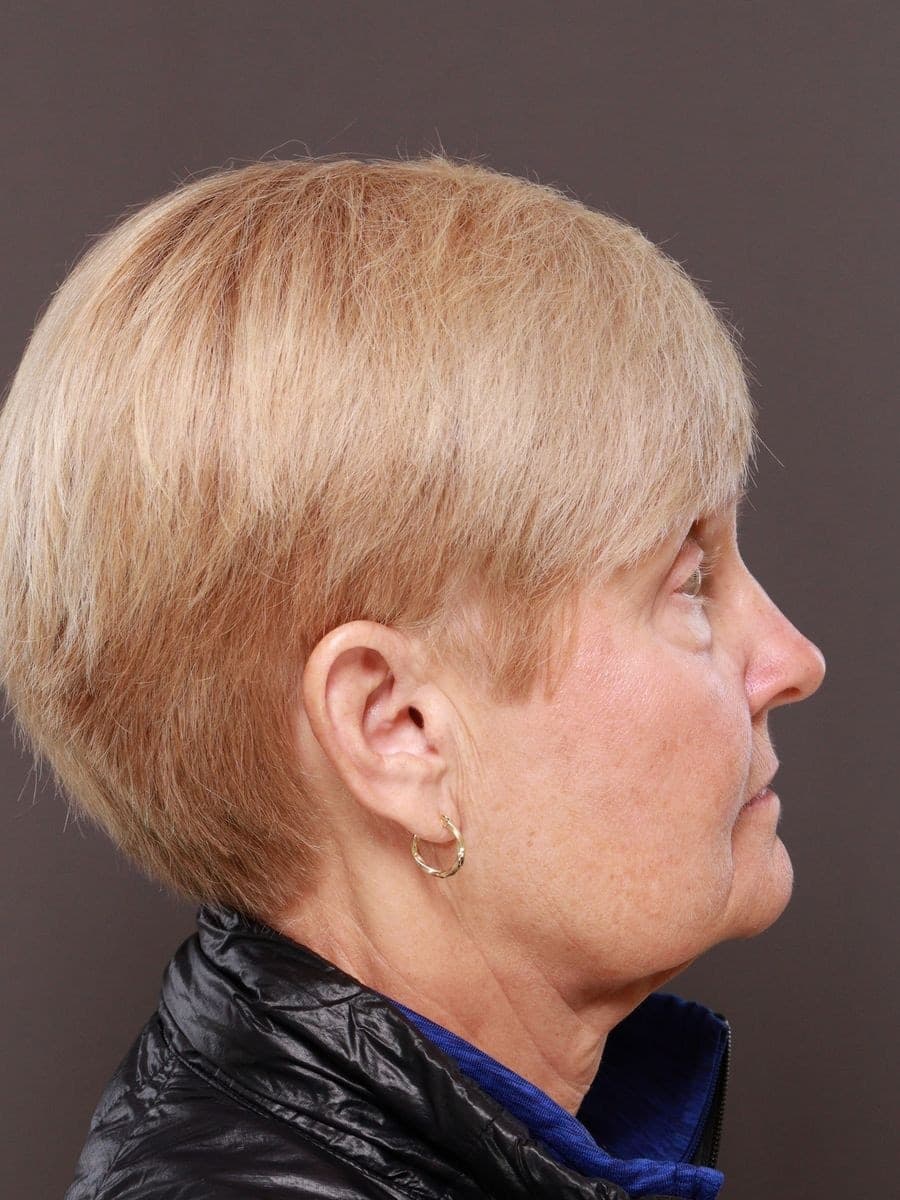
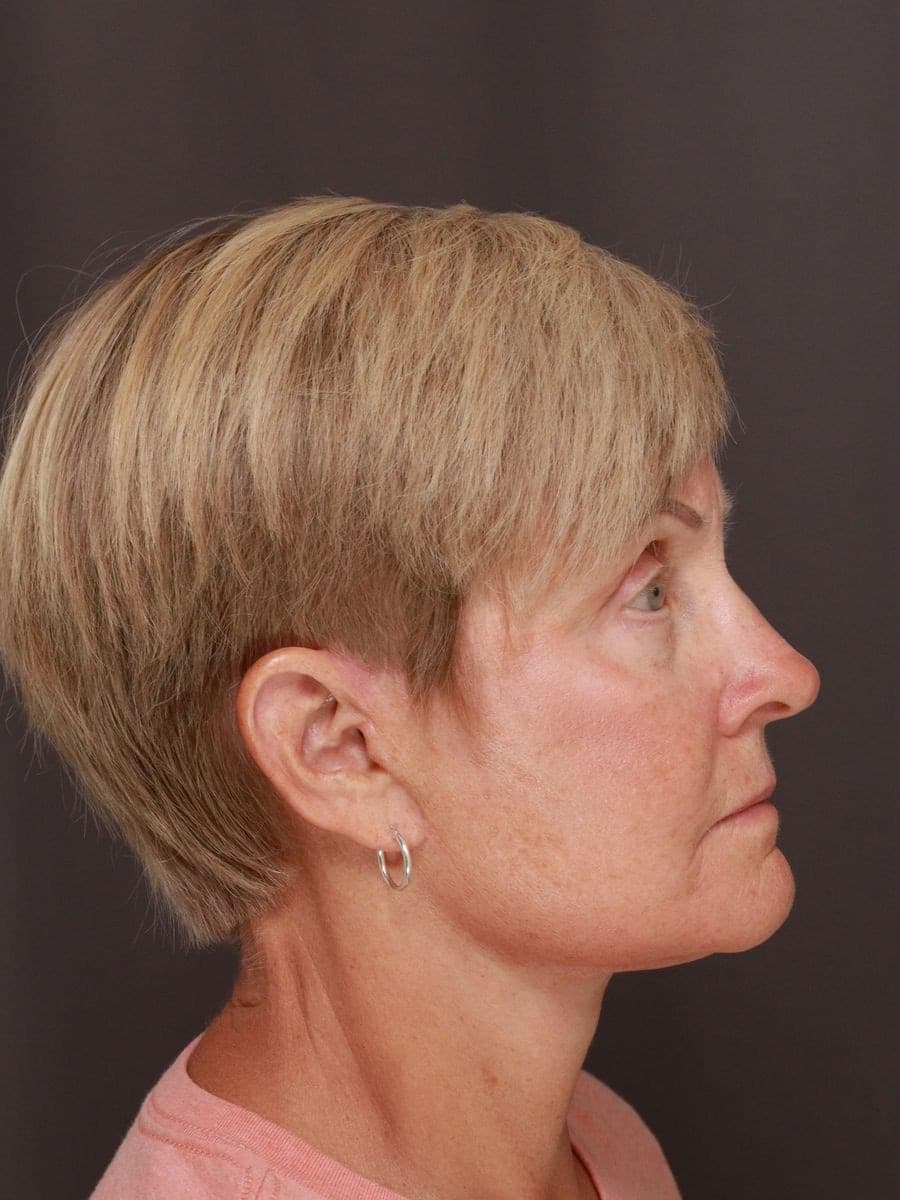
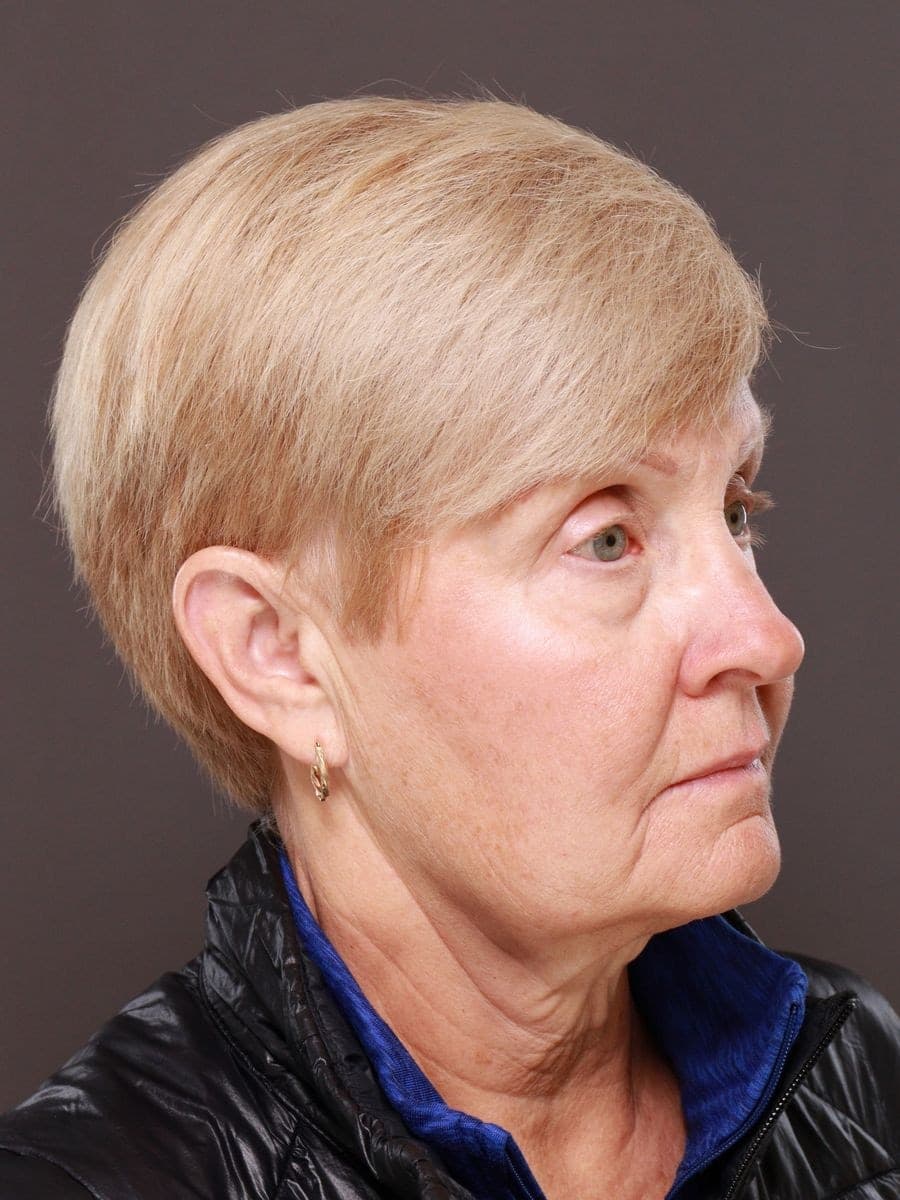
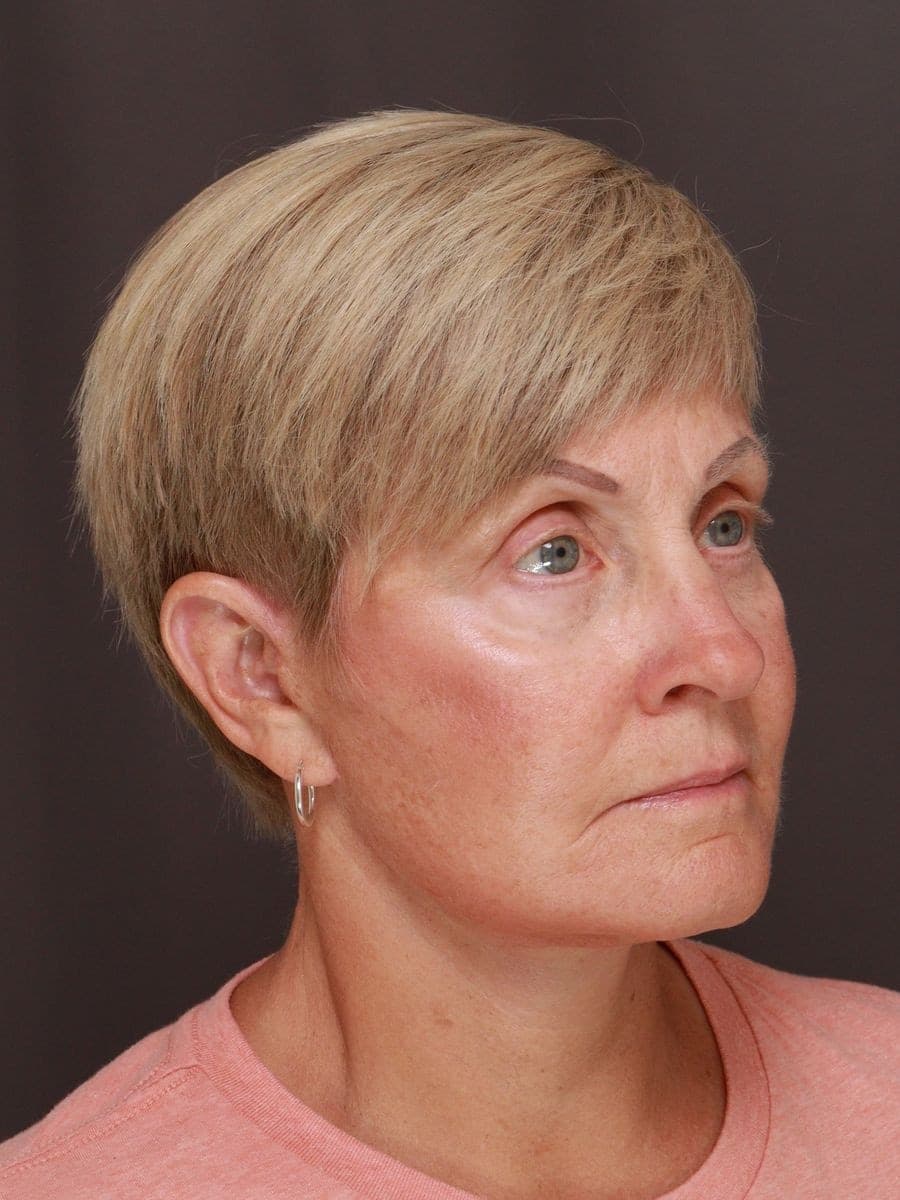
Deep plane facelift and necklift with lower blepharoplasty - 6 months post op
01 / 10
Day 0
Surgery day
About one hour on its own, depending on your anatomy and whether it's combined with other procedures. A short time in recovery, then home.
Days 2–3
Peak swelling
Swelling and bruising crest around the second or third day — expected, and temporary. Bruising may track downward before it fades.
~1 week
Sutures out
The fine crease sutures are usually removed at about one week.
7–10 days
Back to work
Most patients return to non-physical work in roughly seven to ten days, once bruising has faded enough to cover or has resolved.
Weeks–months
Fully refined
The result continues to refine as residual swelling resolves. Being patient with the timeline is part of the process.
Upper blepharoplasty refreshes the upper third of the eye, so it pairs naturally with procedures that address the rest of the eye area and the brow.
Lower blepharoplasty addresses puffiness and excess skin below the eye, and the two are often combined to refresh the whole eye in one session. A brow lift is planned alongside upper blepharoplasty when a low brow is part of the cause of the hooding — treating the lid alone would leave the underlying problem in place. Eyebrow transplant can restore brow density where it has thinned. And fat grafting can add volume back to areas around the eye that have hollowed with age, when the issue is loss of volume rather than excess.
Dr. James Manning is a double board-certified facial plastic surgeon, certified by the American Board of Facial Plastic and Reconstructive Surgery and the American Board of Otolaryngology–Head and Neck Surgery. He specializes exclusively in the face. Upper blepharoplasty is a procedure where conservatism and precise measurement determine whether the result looks rested or operated. Dr. Manning measures the skin and fat removed against each patient’s own anatomy, preserving the deeper tissue layers of the lid, with the goal of a result that is undetectable and that lasts.
Medically reviewed by Dr. James Manning, MD · July 2026
Upper blepharoplasty, also called upper eyelid surgery, is a procedure that removes excess upper-eyelid skin — dermatochalasis — and, where present, the herniated orbital fat causing hooding and heaviness. It is performed under local anesthesia, on an outpatient basis, through an incision hidden in the natural crease of the eyelid.
A good candidate has excess upper-eyelid skin that hoods over the eye, with or without fullness from herniated fat. It often suits patients who feel their lids look heavy or tired, and in more advanced cases, those whose upper field of view is partly blocked by the skin. Candidacy depends less on age than on how much excess has developed and where the brow sits above it.
Upper blepharoplasty removes excess skin and fat from the eyelid itself, while a brow lift repositions a brow that has descended toward the eye. A low brow can be the underlying cause of upper-lid hooding, so the two are sometimes planned together. The evaluation sorts out which one is driving the heaviness before any plan is made.
Sometimes, yes. Upper blepharoplasty removes excess eyelid skin and fat, while ptosis repair tightens the levator — the muscle that raises the lid — when the lid margin itself droops. The two problems often occur together: in one series of 278 patients who came in for excess eyelid skin, up to 21% also needed ptosis repair at the same time. Combining the two is safe, though it carries a modestly higher revision rate than blepharoplasty alone (about 9% versus 4%), which is reviewed at consultation. (Falcon Rodriguez L et al. Plast Reconstr Surg. 2024;154(6):1199-1207. PMID 38315110)
The aim of upper blepharoplasty is to lift the heaviness off the eye while preserving the deeper tissue layers and a conservative amount of fat, so the eye looks rested rather than changed. A hollow or “surprised” look generally comes from removing too much skin or fat, which is why a conservative, measured approach is used.
Temporary dryness in the first weeks after surgery is common and usually managed with lubricating drops. In a 10-year review of 892 blepharoplasty cases, dry eye symptoms were reported in about 27% of patients, and a 2025 meta-analysis of randomized trials found that upper blepharoplasty was associated with a reduction in dry eye symptoms compared with before surgery, with muscle-sparing technique helping to minimize incomplete lid closure. Existing dry eye is assessed at consultation. (Prischmann J et al. JAMA Facial Plast Surg. 2013. PMID 23329270; Todorov D et al. Aesthet Surg J. 2025. PMID 40152471)
When excess upper-eyelid skin is significant, it can obstruct the upper field of view. Studies have found measurable improvement in visual quality after upper blepharoplasty in patients with dermatochalasis, including improvement in contrast sensitivity. Whether your case is functional, cosmetic, or both is determined at consultation. (Altın Ekin M et al. PMID 27672599; Cahill KV et al. PMID 22391740)
For most patients the result lasts many years, and a second upper blepharoplasty is uncommon. The published revision rate after upper blepharoplasty alone is low — about 4% in one large series, most often for a small amount of residual skin. (Falcon Rodriguez L et al. Plast Reconstr Surg. 2024;154(6):1199-1207. PMID 38315110)
Upper blepharoplasty is durable. Removing the excess skin and fat does not reverse aging — it resets the eyelid to a rested position, and from there the clock keeps running. How quickly it runs differs from person to person, and depends on how much excess you started with and how your skin ages afterward. The eyelid skin continues to age after surgery, as all skin does, but it starts from a corrected position.
Several treatments help maintain the quality of the skin around the eyes over time. Energy-based and light-based treatments help preserve collagen and elastin, and medical-grade skin care supports the overall health of the skin.
laser resurfacing · medical-grade skin care
Swelling and bruising peak in the first two to three days and settle from there. The fine crease sutures are usually removed at about one week, and most patients return to non-physical work in roughly seven to ten days. The result continues to refine over the following weeks to a few months as residual swelling resolves.
We would love to see you in consultation to determine if upper blepharoplasty would best fit your needs.
Inquire About Consultations801·317·8687