
In a traditional open structural rhinoplasty, a small incision is made across the columella to provide direct access to the nasal tip structures, including the lower lateral cartilages, upper lateral cartilages, and nasal bones. This approach offers excellent visibility but can contribute to prolonged swelling, particularly in the nasal tip.
In contrast, scarless (closed) rhinoplasty uses incisions placed entirely inside the nose. Through these internal approaches, the surgeon can access and reshape the nasal structures without disrupting the external skin envelope.
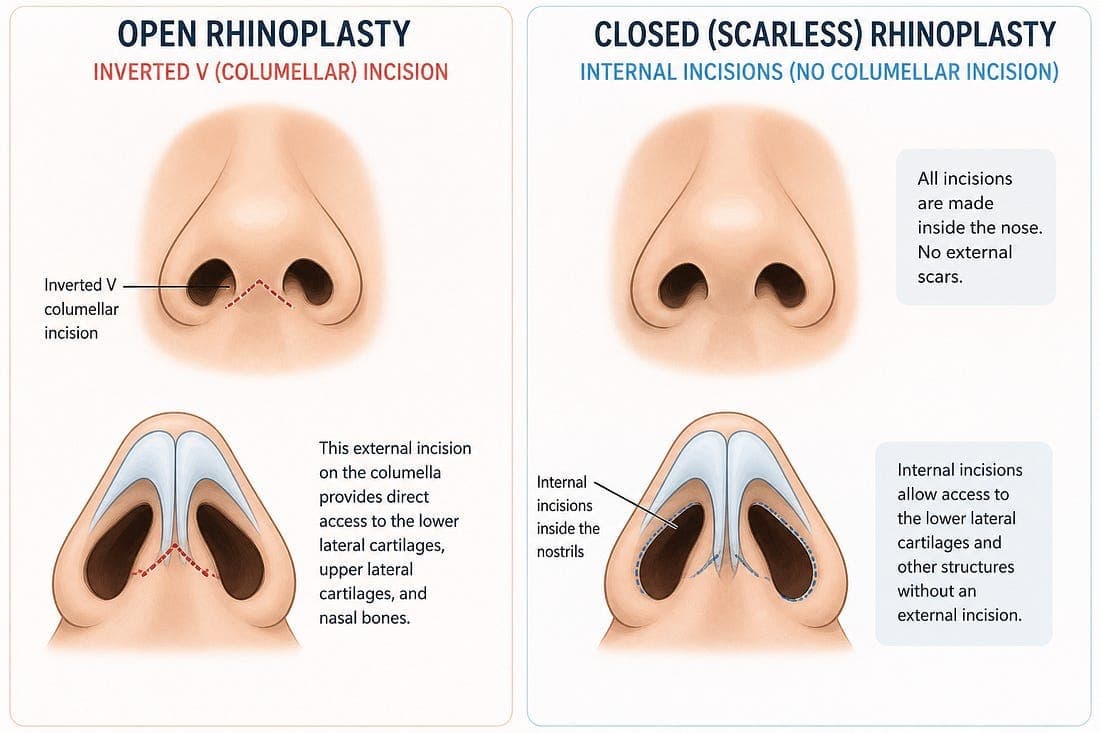
Why avoiding the external incision matters
One of the key advantages of this technique relates to the vascular anatomy of the nasal tip. Important blood supply travels through the columellar skin, and avoiding an external incision helps preserve this circulation. As a result, patients often experience less postoperative swelling and a faster return to a refined tip appearance — sometimes within weeks rather than months.
Although often perceived as a newer approach, closed rhinoplasty has been performed for decades. Its recent resurgence is closely tied to the evolution of preservation rhinoplasty techniques, which emphasize maintaining native structures rather than extensively elevating and disrupting them.
A closed preservation rhinoplasty typically involves fewer incisions, less soft-tissue elevation, and a more efficient healing process.
When an open approach is still the right call
Open structural rhinoplasty remains an important approach for more complex cases and revision surgery, where direct visualization and access are critical. The goal is never the technique for its own sake — it is choosing the approach that fits the anatomy in front of me.
In my practice, I prioritize a closed, scarless technique whenever appropriate. By avoiding an external incision and minimizing soft-tissue disruption, this approach allows for faster healing, reduced swelling, and results that appear more natural in a shorter period of time.